Cambodia’s foreign minister has accused Thailand’s military of continuing to occupy civilian areas inside Cambodian territory, warning that the situation could undermine a fragile ceasefire reached after deadly border clashes last year.
Foreign Minister Prak Sokhonn said Thai forces have fortified several locations along the disputed frontier using barbed wire and shipping containers, preventing thousands of Cambodian families from returning home.
“The Thai military is still occupying territories well inside Cambodia,” Prak Sokhonn said, naming at least four border sites where incursions are alleged. He added that while conditions remain calm for now, the risk of renewed tension remains if the truce is not fully honored.
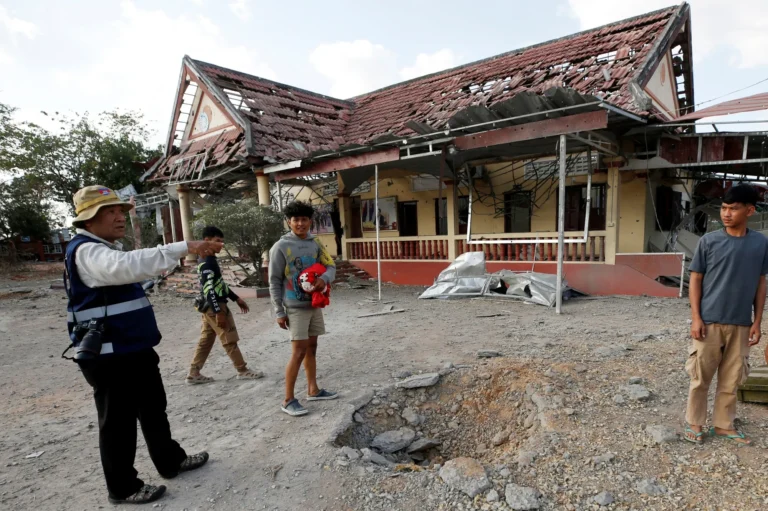
According to Cambodian officials, as many as 4,000 families remain unable to return to their villages despite a ceasefire agreement reached on December 27 that halted weeks of intense fighting.
The truce followed two major flare ups in July and December that involved fighter jet sorties, artillery fire, and rocket attacks. The December fighting alone lasted about 20 days, killing 101 people and displacing more than half a million civilians on both sides of the border, according to officials.
“The occupied village issue will be a priority for us,” Prak Sokhonn said, stressing that displaced residents must be allowed to go home as agreed under the ceasefire.
Thai military and government officials have rejected Cambodia’s claims, pointing to a January 12 statement from Thailand’s foreign ministry that described the allegations as unfounded.
“The maintenance of current troop positions following the ceasefire constitutes direct compliance with agreed de escalation measures,” the ministry said in response to questions from Reuters. “This cannot be misconstrued as territorial occupation.”
Bangkok has said it remains committed to resolving disputes through bilateral mechanisms.
Read Also: Thailand Frees 18 Cambodian Soldiers After Months In Captivity
Cambodia has formally requested a meeting of the Joint Boundary Commission, which is tasked with demarcating the long disputed border. However, Thailand has not yet confirmed its participation.
Thailand’s foreign ministry said preparations for the talks are ongoing and that discussions would resume after a new government is formed following a February 8 election.
“The Thai side reiterates its full commitment to resolving differences through bilateral mechanisms,” the ministry said, adding that it intends to restart commission activities as soon as possible.
Beyond regional diplomacy led by the United States and Malaysia, Prak Sokhonn highlighted China’s involvement in stabilizing the situation.
Chinese officials sent a special envoy to both Bangkok and Phnom Penh in late December, holding meetings with senior leaders, including prime ministers and defense officials on both sides. “It was a very active contribution from China,” Prak Sokhonn said.
Two days after the ceasefire was signed, the foreign ministers of China, Thailand, and Cambodia met in China’s Yunnan province, where they agreed to rebuild trust and prevent further escalation.