Benin has begun granting citizenship to people of African descent whose ancestors were enslaved and taken across the Atlantic, a move aimed at reconnecting the diaspora with one of the most significant departure points of the transatlantic slave trade.
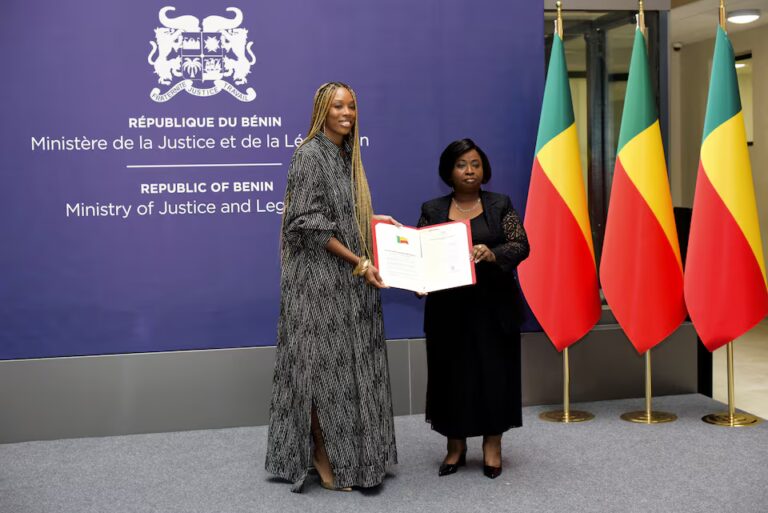
Among the first to be naturalised is Isaline Attelly, a 28 year old content creator originally from the Caribbean island of Martinique. Attelly had been living in Benin for nearly a year when genealogical research confirmed that her great grandmother was born in what is now Benin before being trafficked during the height of the slave trade.
The discovery led Attelly to apply for citizenship through the government’s My Afro Origins programme, a flagship initiative under President Patrice Talon that blends historical reckoning with cultural tourism.
“For me, it’s a source of pride. It feels like my journey has come full circle,” Attelly said after her naturalisation ceremony, according to Reuters. “I am proud and very happy to be able to represent my ancestors.”
The Benin citizenship program targets descendants of enslaved Africans, particularly those from the Caribbean, the Americas, and Europe, whose ancestors were forcibly taken from the region once known as the Kingdom of Dahomey.
Ouidah, a coastal town west of Cotonou, was one of the main departure points for enslaved people sent to the Americas. Historians estimate that millions passed through the area between the seventeenth and nineteenth centuries.
Benin’s government has paired the citizenship drive with large scale memorial projects meant to preserve and present that history to visitors.
Several new sites are under construction in Ouidah, including a modern version of the “Door of No Return,” a symbolic landmark marking the final point of departure for enslaved Africans. Another project features a full scale replica of an eighteenth century slave ship, with sculptures depicting nearly 300 captives confined below deck.
Later this year, authorities plan to open the International Museum of Memory and Slavery at the former residence of Francisco Felix de Souza, a Brazilian born trader who became one of the most influential slave traffickers in the region during the eighteenth and nineteenth centuries.
According to government officials cited by Reuters, the projects are designed to encourage reflection while positioning Benin as a destination for heritage tourism.
President Talon has also leaned on prominent cultural figures to raise international awareness of the initiative. Filmmaker Spike Lee and his wife, producer Tonya Lee Lewis, were named ambassadors to the African American community last year.
Read Also: African Fintech Leaders Call For Unified Virtual Asset Rules
“Our brothers and sisters in Benin are telling us come home, welcome us home, come back to the motherland,” Lee said in an interview with France 24. “Come back to where your roots are.”
Talon, who survived an attempted coup last month, is expected to step down after presidential elections scheduled for April, ending a decade in office. His administration has signaled that the citizenship program and memorial projects will remain central to Benin’s cultural policy beyond his tenure.
As more members of the African diaspora trace their ancestry to West Africa, officials say interest in the program is growing, with additional naturalisation ceremonies expected later this year.