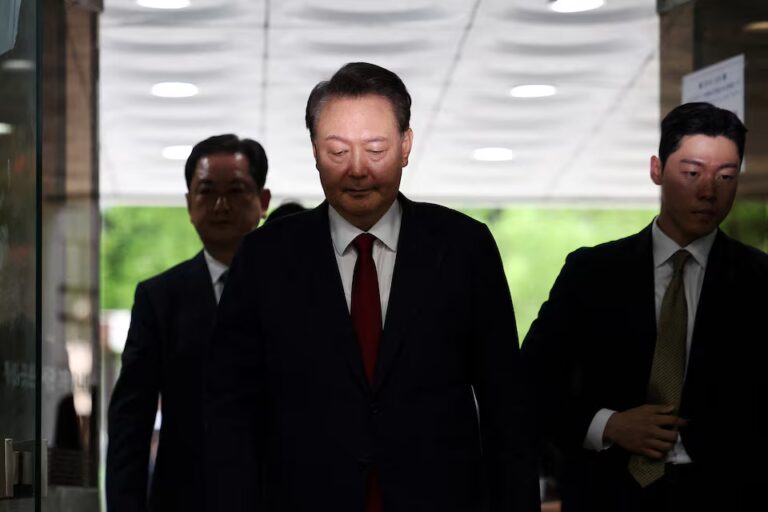
A South Korean court hearing insurrection charges against former President Yoon Suk Yeol delayed prosecutors’ sentencing request on Friday after an unusually long session, pushing the closely watched decision into next week in a case that could carry the death penalty.
The Seoul Central District Court said proceedings would resume on January 13 after more than twelve hours of arguments, as defence lawyers were still presenting their case late into the evening. Prosecutors had been expected to formally request a sentence for Yoon and seven co defendants before the session ended.
The trial centers on accusations that Yoon orchestrated an insurrection through a failed attempt to impose martial law in 2024, an episode that briefly plunged South Korea into political crisis.
If convicted, Yoon could face life imprisonment or the death penalty under South Korean law. Although South Korea has not carried out an execution since 1997, capital punishment remains legal, according to government records cited by Reuters and the BBC.
Prosecutors allege that Yoon, a former career prosecutor, masterminded a plan to suspend parliament and seize legislative authority. Court filings say the plot was developed with then defence minister Kim Yong hyun as early as October 2023.
According to prosecutors, Yoon sought to portray political rivals as “anti state forces,” including then opposition leader Lee Jae Myung, and intended to detain key figures once martial law was declared.
They also accuse Yoon and Kim of attempting to manufacture a justification for martial law by inflaming tensions with North Korea, including through a covert drone operation. Prosecutors argue the plan was designed to create a national security emergency that would justify extraordinary powers.
The martial law declaration lasted only about six hours before collapsing under political and public pressure. Still, the episode sent shockwaves through South Korea, which is Asia’s fourth largest economy and a major United States security ally long regarded as one of the region’s most resilient democracies.
Analysts quoted by AFP said the case has become one of the most consequential legal challenges faced by a former South Korean leader since the country’s democratic transition.
Read Also: South Korea Indicts Ex-leader Yoon On Aiding Enemy Charge
Yoon, 65, has denied all charges. His legal team argues that the constitution grants the president authority to declare martial law and that his actions were intended to warn against what he described as legislative obstruction by opposition parties.
In South Korea’s legal system, the same court determines both guilt and sentencing, making the upcoming session critical for the former president’s fate.
The court is expected to hear the remaining defence arguments on January 13 before prosecutors formally request sentences. A verdict date will be set afterwards.