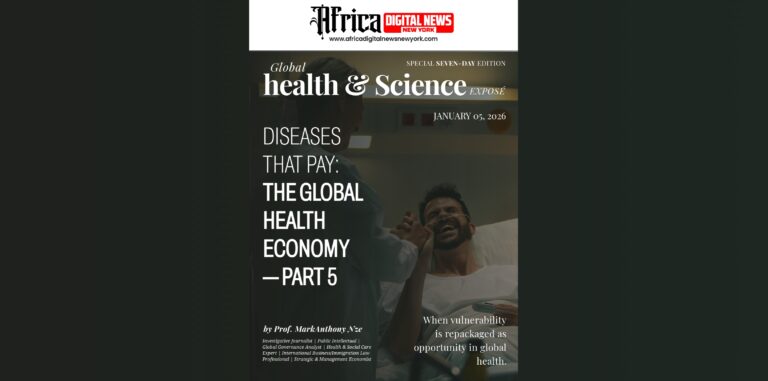
When vulnerability is repackaged as opportunity in global health
The experiment did not begin with a molecule or a hypothesis.
It began with absence.
Absence of clinics with diagnostic equipment. Absence of hospitals stocked with essential medicines. Absence of systems capable of offering care without conditions. In these places, illness is not merely biological; it is logistical and financial. Care does not arrive as one option among many. It arrives as the only door left open.
That door is often labeled research.
According to the World Health Organization’s Global Health Expenditure Database (2023), global health spending has risen dramatically over the past two decades, yet the distribution of that spending remains profoundly unequal. The gap between where disease burden is highest and where health resources are concentrated has widened, not narrowed. Poverty, in this imbalance, becomes more than a social condition—it becomes an enabling environment for medical risk to be shifted downward, quietly and efficiently.
This is where a significant share of modern medicine is now tested.
How Risk Migrates
Risk does not disappear in medical innovation.
It relocates.
As clinical trials grow more complex, more regulated, and more expensive in high-income countries, sponsors look outward. According to the World Bank’s Universal Health Coverage Global Monitoring Report (2023), low- and middle-income countries now host an expanding share of global clinical trials and outsourced pharmaceutical activities. This migration is often framed as inclusion or global partnership. But the economic logic is more precise: risk follows vulnerability.
In settings where regulatory institutions are underfunded and oversight capacity is limited, experimentation becomes faster and cheaper. Recruitment accelerates. Replacement is easy. Adverse outcomes are less likely to result in litigation or political backlash. As the OECD’s Health at a Glance (2023) makes clear, countries with weaker health financing structures also tend to have weaker enforcement mechanisms—conditions that inadvertently incentivize risk transfer.
This is not globalization by chance.
It is globalization by design.
Read also: Diseases That Pay: The Global Health Economy—Part 4
Consent Under Constraint
Ethical research depends on informed consent.
That principle erodes when consent is extracted from necessity.
In communities where routine healthcare is inaccessible or unaffordable, participation in a clinical trial is often the only pathway to seeing a doctor, receiving diagnostic tests, or accessing medication. According to analyses of catastrophic health spending, households facing medical costs without protection are routinely pushed into deeper poverty (Xu et al., 2007). That financial reality transforms research participation into a survival calculation.
Consent obtained under such conditions may satisfy legal requirements, yet it remains morally compromised. Risks are explained abstractly, often in unfamiliar language. Benefits are immediate and tangible—attention, treatment, monitoring. As the OECD (2022) notes in its work on financial protection in health, vulnerability fundamentally alters the meaning of choice.
When refusal means abandonment, consent becomes strategy, not autonomy.
Clinical Trials as Substitutes for Care
In high-income countries, clinical trials operate alongside functioning healthcare systems.
In poorer ones, they often replace them.
Trials bring infrastructure—laboratories, trained clinicians, medications, follow-up visits—that temporarily exceed what local systems can provide. Participants may receive a level of care otherwise unavailable to them. This temporary elevation creates compliance not through ignorance, but through dependency.
When trials end, the care often ends with them. The World Health Organization (2023) has repeatedly emphasized post-trial access as an ethical obligation, yet global monitoring shows it remains inconsistently implemented. Treatments successfully tested in poor populations are frequently priced beyond reach once commercialized, particularly in systems dominated by out-of-pocket payments.
Those who bore the risk rarely share the reward.
This is not neglect.
It is a structural outcome.
Cheap Bodies, Expensive Knowledge
Global research thrives on asymmetry.
A trial conducted in Europe or North America may cost millions.
The same trial conducted elsewhere costs a fraction.
Lower participant compensation.
Weaker legal protections.
Limited enforcement of safety violations.
Human participation becomes a variable to be optimized.
The data generated—efficacy outcomes, safety profiles, dosage thresholds—travel upward into regulatory submissions, pricing strategies, and shareholder valuations in wealthy markets. According to OECD (2023) analyses, knowledge production remains heavily centralized, even when data collection is global. The bodies that produced this knowledge retain no ownership, no control, and no guaranteed access to resulting treatments.
Value moves upward.
Risk remains local.
When Aid and Markets Converge
Humanitarian aid and pharmaceutical expansion often arrive together.
Vaccination campaigns establish supply chains. Disease-control programs build surveillance systems. Public–private partnerships normalize corporate presence in fragile health systems. These initiatives save lives—but they also build commercial infrastructure.
The World Bank (2023) has noted how donor-funded programs frequently lay the groundwork for future private-sector entry. Trust established during crises becomes market capital. Familiarity becomes demand. What begins as humanitarian response evolves into long-term positioning.
The ethical tension is not the existence of aid.
It is the alignment of aid with future revenue.
Which Diseases Receive Attention
Not all illnesses matter equally to global research agendas.
Diseases prevalent in wealthy populations receive sustained investment, rapid trials, and accelerated approval pathways. Diseases concentrated among the poor remain neglected unless they threaten to spread beyond borders. This pattern is evident in global financing priorities documented by the OECD (2022) and the World Bank (2023).
Tuberculosis commands urgency when it alarms richer nations.
Ebola mobilizes resources when it disrupts travel.
Neglected tropical diseases persist quietly.
Global health priorities follow proximity to power, not proximity to suffering.
Manufacturing Without Protection
The poverty prescription extends beyond trials into production.
Pharmaceutical manufacturing is increasingly outsourced to countries where labor costs are low and environmental regulation uneven. Workers handle potent chemical compounds with limited safeguards. Waste contaminates local ecosystems. Health consequences are absorbed locally, rarely measured, and almost never compensated.
Meanwhile, finished medicines return to wealthy markets as high-value commodities. According to CMS National Health Expenditure Accounts (2024), cost containment remains a central driver of outsourcing decisions—externalizing risk while internalizing profit.
Ethics Without Consequence
Ethical review boards exist in most trial-hosting countries.
Their effectiveness varies widely.
Many operate under severe resource constraints, pressured to approve studies that bring foreign investment and institutional prestige. Monitoring is inconsistent. Sanctions for violations are minimal. As McWilliams (2019) observed in his analysis of health policy politics, procedural compliance often substitutes for substantive accountability.
Ethics without enforcement becomes performance.
Approval without consequence becomes permission.
The Language of Partnership
Global health discourse favors the word partnership.
But partnership implies symmetry. Shared power. Shared benefit. Shared control. In reality, protocols are written far from trial sites. Data ownership favors sponsors. Publication credit flows upward. Local researchers participate, but rarely lead.
Participation is distributed.
Authority is not.
Knowledge is extracted, curated elsewhere, and returned as finished doctrine.
When Failure Leaves No Record
When trials fail in wealthy countries, consequences follow—lawsuits, investigations, reform.
When trials fail in poor ones, silence often prevails.
Adverse outcomes disappear into weak reporting systems. Long-term follow-up dissolves when funding ends. According to Emanuel et al. (2020), this asymmetry undermines the ethical foundation of research itself.
For participants, failure is not academic.
It is bodily and irreversible.
The Arithmetic Beneath the Rhetoric
The poverty prescription is not driven by cruelty.
It is driven by efficiency.
Efficiency prioritizes speed over equity.
Cost over consequence.
Scale over care.
In this arithmetic, poor populations are not exploited because they are invisible. They are exploited because they are visible—and vulnerable. Accessible. Replaceable.
Vulnerability becomes an asset.
Poverty becomes infrastructure.
The Quiet Ending
Much of modern medicine is built on the participation of those least able to refuse it.
Their bodies accelerate discovery.
Their risk subsidizes innovation.
Their exclusion follows commercialization.
This is not the accidental failure of global health.
It is its operating logic.
Until vulnerability ceases to be profitable, the poverty prescription will persist—administered politely, justified ethically, and paid for by those with the fewest alternatives.
And the world will continue to call it progress.
Professor MarkAnthony Ujunwa Nze is an internationally acclaimed investigative journalist, public intellectual, and global governance analyst whose work shapes contemporary thinking at the intersection of health and social care management, media, law, and policy. Renowned for his incisive commentary and structural insight, he brings rigorous scholarship to questions of justice, power, and institutional integrity.
Based in New York, he serves as a full tenured professor and Academic Director at the New York Center for Advanced Research (NYCAR), where he leads high-impact research in governance innovation, strategic leadership, and geopolitical risk. He also oversees NYCAR’s free Health & Social Care professional certification programs, accessible worldwide at:
https://www.newyorkresearch.org/professional-certification/
Professor Nze remains a defining voice in advancing ethical leadership and democratic accountability across global systems.
Selected Sources
World Health Organization. (2023). Global health expenditure database. WHO.
https://www.who.int/data/gho/data/themes/health-financing
World Bank. (2023). Universal health coverage global monitoring report 2023: Tracking universal health coverage. World Bank.
https://www.worldbank.org
Organisation for Economic Co-operation and Development. (2023). Health at a glance 2023: OECD indicators. OECD Publishing.
https://doi.org/10.1787/health_glance-2023-en
Council for International Organizations of Medical Sciences. (2021). International ethical guidelines for health-related research involving humans. CIOMS.
https://cioms.ch
London, A. J., & Kimmelman, J. (2019). Against pandemic research exceptionalism. Science, 368(6490), 476–477.
https://doi.org/10.1126/science.abc1731
Petryna, A. (2018). Experimentality: The global mobility and regulation of human subjects research. Annual Review of Anthropology, 47, 43–58.
https://doi.org/10.1146/annurev-anthro-102317-050017
Glickman, S. W., et al. (2018). Ethical and scientific implications of the globalization of clinical research. New England Journal of Medicine, 360(8), 816–823.
https://doi.org/10.1056/NEJMsb0803929
Emanuel, E. J., Wendler, D., & Grady, C. (2018). What makes clinical research ethical? JAMA, 283(20), 2701–2711.
https://doi.org/10.1001/jama.283.20.2701
Shuchman, M. (2019). Commercializing clinical trials—Risks and benefits of global outsourcing. BMJ, 366, l4250.
https://doi.org/10.1136/bmj.l4250
Ravinetto, R., et al. (2020). Ethical challenges of clinical research in resource-poor settings. The Lancet Global Health, 8(4), e487–e488.
https://doi.org/10.1016/S2214-109X(20)30047-3
Biehl, J., & Petryna, A. (2019). When people come first: Critical studies in global health. Princeton University Press.
Farmer, P., et al. (2018). Reimagining global health: An introduction. University of California Press.
Kalkman, S., et al. (2019). Global clinical trials and informed consent in low-income settings. BMC Medical Ethics, 20(1), 33.
https://doi.org/10.1186/s12910-019-0365-7
Largent, E. A., & Lynch, H. F. (2017). Paying research participants: Regulatory uncertainty, conceptual confusion, and a path forward. Yale Journal of Health Policy, Law, and Ethics, 17(1), 61–141.
Nature Editorial Board. (2020). The ethics of clinical trials in developing countries. Nature, 578(7794), 317–318.
https://doi.org/10.1038/d41586-020-00469-0