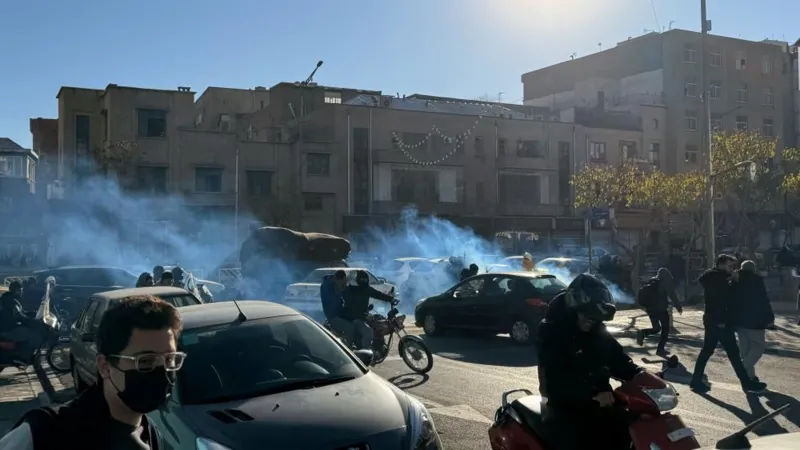
At least 16 people have been killed across Iran during a week of nationwide protests, according to rights groups, as demonstrations over soaring inflation escalated into violent confrontations between protesters and security forces.
Deaths and hundreds of arrests have been reported by both Iranian state media and independent rights organizations, though figures vary and could not be independently verified. The unrest marks the largest wave of protests in Iran in three years, emerging amid deep economic strain and rising international pressure on Tehran.
The demonstrations began among bazaar merchants and shopkeepers before expanding to university students and residents in provincial cities. Protesters in several locations have chanted slogans critical of Iran’s clerical leadership, according to activists and videos circulating online.
Clashes have been most intense in western Iran, but protests have also been reported in Tehran, parts of central Iran, and the southeastern Baluchistan province, underscoring the breadth of the unrest.
Rights group HRANA said at least 16 people had been killed and 582 arrested since the protests began. Kurdish rights organization Hengaw put the death toll slightly higher, reporting at least 17 fatalities.
Iranian authorities said security forces have intensified efforts to detain protest organizers. Police chief Ahmad-Reza Radan told state media that officers had focused on arresting protest leaders in recent days, including those coordinating demonstrations online.
“A large number of leaders active in virtual spaces have been detained,” Radan said, without providing exact figures.
Both HRANA and the state-affiliated Tasnim news agency reported the arrest of administrators of online accounts accused of encouraging protests.
In the religious city of Qom, the provincial governor said late Saturday that two people were killed during unrest. One of the deaths, he said, occurred when an explosive device allegedly being assembled detonated prematurely.
The protests have also drawn international attention. U.S. President Donald Trump warned on Friday that Washington could act if Iranian authorities used violence against demonstrators, stating that the United States was “locked and loaded and ready to go,” without specifying potential measures.
Read Also: Trump Warning On Iran Protests Draws Fierce Tehran Response
The remarks triggered swift backlash from Tehran. Senior Iranian officials warned of retaliation against U.S. forces in the region, while Supreme Leader Ayatollah Ali Khamenei said Iran “will not yield to the enemy,” signaling resistance to external pressure.
Iran’s worsening economic conditions have been widely cited as a key driver of the unrest. Inflation has remained above 36% since the start of the Iranian calendar year in March, sharply reducing purchasing power.
At the same time, the rial has lost roughly half its value against the U.S. dollar, deepening hardship for households and businesses already struggling with sanctions and unemployment.
Once sporadic, the protests have gained momentum as economic frustration converges with political discontent, creating a volatile environment for Iran’s leadership.