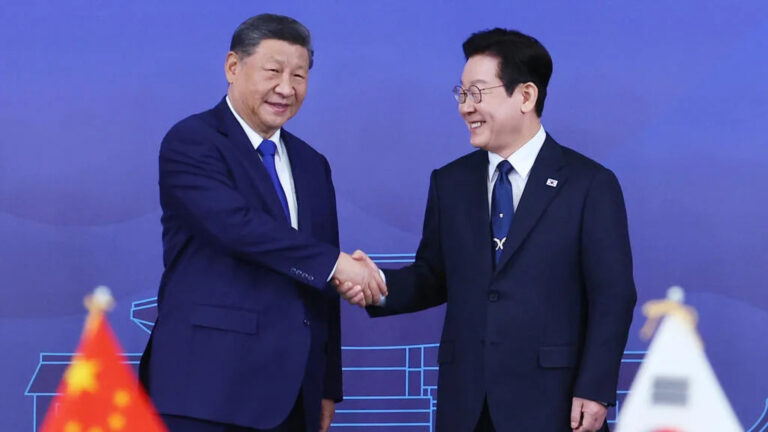
Chinese President Xi Jinping is set to host South Korean President Lee Jae Myung on a state visit beginning Sunday, a move widely seen as Beijing’s effort to tighten ties with Seoul as regional tensions rise over Taiwan and relations with Japan remain strained.
The visit comes barely two months after Xi and Lee last met, an unusually short gap for top level diplomacy that highlights China’s urgency in strengthening political and economic links with South Korea. Analysts say the timing also reflects Beijing’s desire to engage Seoul ahead of Lee’s expected visit to Japan.
China and Japan relations have deteriorated sharply in recent months, reaching their lowest point in years after Japanese Prime Minister Sanae Takaichi suggested in November that Tokyo could consider military action if China moved against Taiwan. Against that backdrop, Beijing’s outreach to Seoul appears carefully calculated.
“China wants to signal that South Korea matters more than before,” Kang Jun young, a professor of political economics at Hankuk University of Foreign Studies, told Reuters. He added that Beijing likely preferred Lee to visit China before holding another summit with Japan.
Lee’s office has described the visit as a turning point in bilateral ties. Wi Sung lac, Lee’s national security adviser, said on Friday that the summit could open a “new chapter” in relations between the two neighbors.
According to South Korean officials, both sides are preparing more than ten agreements covering areas such as trade, business cooperation, climate policy and tourism. While no joint statement is planned, the volume of expected deals underscores the economic focus of the talks.
China is South Korea’s largest trading partner, a reality that the Lee administration has repeatedly acknowledged. Seoul has said it wants to restore relations with Beijing after several years of tension under former president Yoon Suk Yeol, whose government aligned more closely with Washington and Tokyo and took a firmer public stance on Taiwan.
Lee has sought a more balanced approach. In December, he said South Korea would not take sides in disputes between China and Japan, signaling caution amid intensifying rivalry in East Asia.
Read Also: South Korea Triples AI Spending; Qatar Launches MAI Platform
Despite warmer rhetoric, the relationship is shaped by complex security dynamics. South Korea remains a key ally of the United States, even as China increasingly challenges US influence in the region.
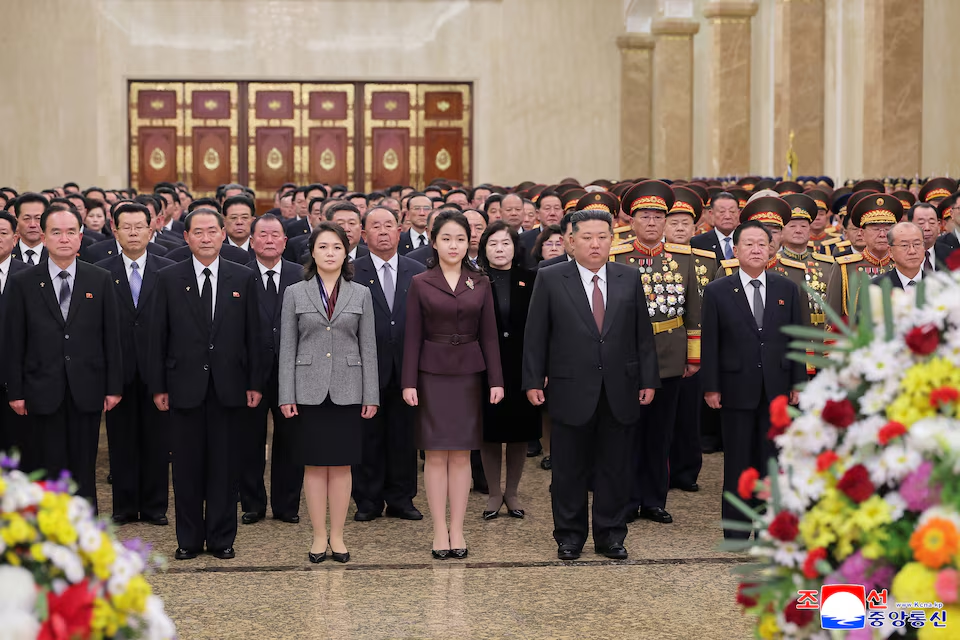
North Korea also looms large over the talks. Beijing is Pyongyang’s main diplomatic supporter and economic lifeline, while Seoul remains on edge over the North’s nuclear and missile programs.
Shin Beom chul, a former South Korean vice defense minister and senior fellow at the Sejong Institute, said Xi and Lee were likely to discuss sensitive topics including efforts to update the South Korea US alliance. Such discussions, analysts say, will test how far Seoul can deepen cooperation with Beijing while maintaining its security commitments.