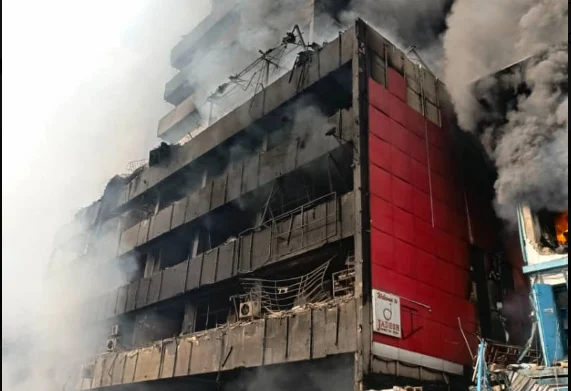

Early morning fire tears through Ikotun Market plaza, destroying electronics shops worth billions as firefighters struggle with smoke and water shortages.
A massive fire swept through the electronics section of Ikotun Market in Lagos early on New Year’s Day, destroying goods worth billions of naira and raising renewed concerns over fire safety in Nigeria’s commercial hubs.
The blaze broke out around 12:05 a.m. on January 1, 2026, at the market’s electronics plaza, a densely packed cluster of shops that serves as a major distribution point for phones, computers, and household electronics in Africa’s most populous city. By the time firefighters arrived, flames had already spread across multiple buildings, sending thick plumes of smoke into the night sky.
Videos shared by eyewitnesses on social media showed traders and residents watching helplessly as the fire raged. Several clips captured firefighters battling the inferno under difficult conditions, with some witnesses reporting apparent shortages of water that slowed containment efforts.
Many shop owners were not present at the time of the fire, having traveled out of Lagos for the Christmas and New Year holidays. As a result, large volumes of merchandise were left unattended, compounding losses as the flames tore through locked stalls and warehouses.
Read Also: Sanwo-Olu Orders Demolition Of Fire-Hit 22-Storey Office Tower
Officials have not yet released an official cause of the fire, nor have they confirmed whether there were any casualties. Emergency responders continued cooling operations into the early hours of the morning to prevent re-ignition, while police cordoned off parts of the market to allow investigators access to the scene.
Ikotun Market is one of Lagos’s busiest trading centers, drawing merchants and buyers from across southwestern Nigeria. Fires are a recurring threat in such markets, where overcrowding, aging electrical systems, and limited access routes often complicate emergency response.
The incident comes just days after a deadly Christmas Eve fire at Balogun Market on Lagos Island, which killed at least six people and destroyed dozens of shops. That tragedy had already intensified public criticism of what many see as inadequate fire preparedness and weak enforcement of safety standards across the city’s markets.
Lagos State authorities have repeatedly pledged to upgrade firefighting infrastructure and improve safety oversight. However, traders say repeated disasters point to deeper structural problems, including poor urban planning and insufficient inspections.
As daylight revealed the full scale of destruction in Ikotun, affected business owners began assessing the damage, many facing the prospect of starting over without insurance or immediate support. For now, the New Year’s blaze stands as another stark reminder of the vulnerabilities facing informal and formal commerce alike in Nigeria’s economic capital.