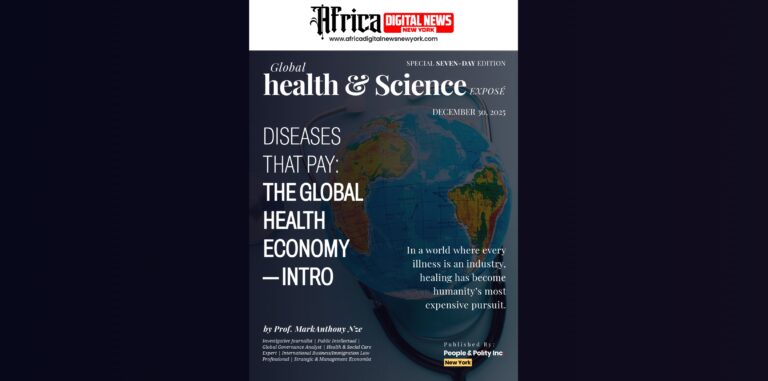
In a world where every illness is an industry, healing has become humanity’s most expensive pursuit.
By Prof. MarkAnthony Nze
Introductory Overview
How the World Learned to Monetize Sickness
There was a time when medicine was a calling, and when the physician’s oath was a covenant between compassion and science. But somewhere along the fluorescent corridors of the twenty-first century, the language of healing changed. The patient became a consumer, the hospital a revenue center, the prescription pad a financial instrument. In this new moral arithmetic, illness is no longer an interruption of life — it is an industry.
Across the world, disease has become one of humanity’s most reliable investments. Cancer drugs now yield profit margins higher than oil. Insulin generates more annual revenue than some nations’ GDPs. In 2025, global health spending surpassed seventeen trillion dollars, outpacing defense, energy, and technology combined. Yet, more than two billion people still live without access to basic healthcare. The contradiction is surgical — the poorer the population, the richer the profit pool.
Every epidemic now leaves behind two survivors — the patients who live, and the corporations that thrive.
The Marketplace of Misery
The machinery of modern healthcare runs on a paradox. The more efficient science becomes at detecting disease, the more markets it creates. A new diagnostic test doesn’t just reveal illness — it expands the definition of who can be treated, and therefore, billed. Preventive medicine has evolved into predictive commerce, where algorithms forecast not just risk, but revenue.
Pharmaceutical companies call this “innovation.” Economists call it “health capitalization.” The moral question is buried in the semantics: when the cure depends on the continuation of the disease, who benefits from recovery?
Behind every glossy public campaign for wellness lies a darker symmetry of interests. Clinical trials are funded by those who stand to profit from their success. Medical guidelines are drafted by panels that often receive consulting fees from the same firms whose drugs they recommend. Even charitable health foundations now function as philanthropic subsidiaries of multinationals — relief with a return on investment.
The result is a system that measures compassion in quarterly reports.
Read also: Reverse Diabetes Naturally In 90 Days—No Pills
The Silent Strategy of Control
No single institution designed this system. It evolved through centuries of ambition, necessity, and neglect. The earliest hospitals were sanctuaries of mercy, funded by faith and community. But with industrial capitalism came the logic of scale, and health — once a local duty — became a global commodity.
Today, five conglomerates dominate seventy percent of the global drug market. A single vaccine patent can determine the diplomatic posture of entire continents. Insurance megafirms decide who receives surgery and who receives sympathy. The price of life itself is set not in hospitals but in boardrooms.
Governments, too, have learned to play this arithmetic. The health budget is no longer an expense — it is a portfolio. Policy decisions are made with an eye on trade, not treatment. Regulatory agencies are staffed by former executives from the industries they are meant to monitor. The revolving door between government and pharma spins with clinical precision.
This is not conspiracy; it is capitalism perfected.
The Poor as the World’s Laboratory
In the global south, health is not only a service — it is a frontier of extraction. Developing nations supply both the patients and the profits. Drug trials are outsourced to communities with low oversight and high desperation. Generic production is restricted by patent laws written in the north and enforced through trade deals dressed as cooperation.
The result is a hierarchy of healing. Western markets receive innovation; African and Asian ones receive experimentation. A vaccine that saves lives in Lagos becomes a stock price in London. A drug tested in Mumbai becomes a political talking point in Washington.
The economics are ruthless because they are rational. Illness is predictable, recurring, and infinitely marketable. It is, in business terms, the perfect product — one that requires continuous consumption.
The Technology of Dependence
The fourth industrial revolution promised to democratize health through technology. Instead, it digitized dependency. Wearable devices record every heartbeat and transmit it to companies that sell wellness data to insurers. Telemedicine has become the new frontier for algorithmic triage — a system that diagnoses in seconds but bills in perpetuity.
Artificial intelligence now predicts who will fall ill before they do, transforming prevention into preemption — and preemption into perpetual subscription. The human body has become an open-source commodity, its biology translated into data streams traded across servers.
What once belonged to the patient now belongs to the platform.
The Economics of the Body
The moral question is not whether health should be profitable — it is whether profit should define health. When disease becomes the foundation of economies, human life becomes collateral. We now inhabit a world where a new drug launch can raise stock markets, but a new epidemic can stabilize them. The COVID-19 pandemic revealed the scale of this paradox: trillions lost in productivity, trillions earned in pharmaceuticals, vaccines, and data systems.
The line between cure and commerce has dissolved. The industry of health has learned to profit equally from sickness and survival.
For nations like Nigeria, India, and Brazil, this revelation is existential. Their citizens serve as both the consumers and commodities of global medicine — buying drugs whose prices are determined by markets they did not design. Health ministries negotiate not with healers, but with hedge funds.
The inequality is not moral; it is mathematical. The same statistical models that predict global disease burden also predict profit yield. The same software used to optimize hospital logistics is used to forecast revenue per patient. In this calculus, care becomes a variable — cost to be contained, not value to be expanded.
Reclaiming Humanity from the Ledger
The question that remains is simple: can medicine still serve humanity without selling it? Can healing exist outside the logic of monetization? The answers are not found in policy but in philosophy — in whether societies can rediscover the moral grammar of health.
The 1948 Universal Declaration of Human Rights defined healthcare as a right. Seventy-seven years later, it has become an asset class.
The world stands at a moral threshold. Either it redefines health as a public trust, or it continues to trade it as private equity. The stakes are no longer theoretical; they are biological.
As the global economy grows wealthier on disease, humanity must decide whether it wants to be cured or merely managed.
This Africa Digital News, New York investigation — Diseases That Pay: The Global Health Economy — will expose, over seven days, how profit has colonized the bloodstream of global health, how science became subservient to shareholders, and how compassion can still reclaim its rightful place in the anatomy of power.
Because the greatest pandemic of our time is not viral — it is structural.
Professor MarkAnthony Ujunwa Nze is an internationally acclaimed investigative journalist, public intellectual, and global governance analyst whose work shapes contemporary thinking at the intersection of health and social care management, media, law, and policy. Renowned for his incisive commentary and structural insight, he brings rigorous scholarship to questions of justice, power, and institutional integrity.
Based in New York, he serves as a full tenured professor and Academic Director at the New York Center for Advanced Research (NYCAR), where he leads high-impact research in governance innovation, strategic leadership, and geopolitical risk. He also oversees NYCAR’s free Health & Social Care professional certification programs, accessible worldwide at:
👉 https://www.newyorkresearch.org/professional-certification/
Professor Nze remains a defining voice in advancing ethical leadership and democratic accountability across global systems.