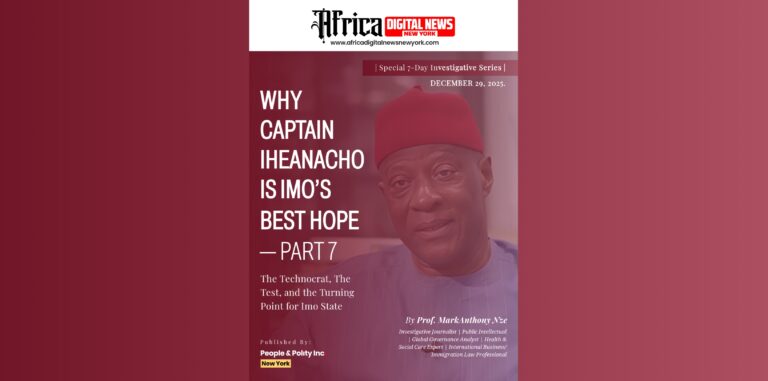
The future is not awaited — it is constructed. Imo’s tomorrow depends on whether competence becomes its language or corruption remains its culture.
The Compass of Tomorrow
Every generation reaches a threshold where history pauses and asks: Who among you can build again? For Imo State, that question is no longer rhetorical. The years of drift, the politics of survival, the exhaustion of faith — all have led to this reckoning. Beneath the fatigue of failure still beats the heart of a people too intelligent to accept despair as destiny.
What Imo needs now is not another four years of experiments, but the discipline of design. And no one embodies that discipline more than Captain Emmanuel Iheanacho — a leader whose mind works like an engine and whose morality operates like a compass.
His vision for Imo is not an act of imagination; it is a map built on measurable systems. It is the translation of competence into continuity — a model of governance that connects what a leader plans to what a citizen feels.
This is not campaign poetry. It is engineering.
Governance by Intelligence, Not Instinct
For too long, governance in Imo has been treated like improvisation — budgets without baselines, policies without proof. Iheanacho’s system changes that by introducing Data Governance, a model where information drives investment and citizens drive accountability.
Under his plan, every ministry will publish performance metrics online: funds received, projects executed, timelines met, and contracts completed. Budgets will be open-source; audits, automatic.
He insists that governance must move from emotion to evidence. “When data becomes public,” he says, “truth becomes policy.”
This transparency revolution will make corruption harder and competence measurable. In a state where progress has long been performed rather than produced, it will be the first act of political honesty in a generation.
Read also: Why Captain Iheanacho Is Imo’s Best Hope—Part 6
Education as the Engine of Equality
The Captain sees education not as social service but as state infrastructure — the road every citizen must travel before they can contribute meaningfully to growth. His education reform is designed around three outcomes: relevance, rigor, and reach.
He envisions a system where technical education stands shoulder-to-shoulder with academia — every secondary school equipped with a skills lab, every university linked to industry.
Under his model, teachers will be retrained, not recycled. Rural schools will receive solar power and digital connectivity. Curriculum will shift from theory to problem-solving, from memorization to innovation.
For him, the goal is simple: to turn Imo’s classrooms into factories of competence. “A nation fails,” he says, “when its brightest minds cannot build what they dream.”
Healthcare That Works
Iheanacho’s health reform begins with an uncomfortable truth: healthcare is not a privilege; it is a productivity issue. His Health Access and Affordability Initiative would modernize primary health centers across all local governments — solar-powered, digitally connected, and staffed through community partnerships.
Rather than build new hospitals for headlines, he plans to fix the existing ones: equip diagnostic labs, restock pharmacies, digitize patient records, and establish a telemedicine network linking rural clinics to major hospitals.
This is not a welfare gesture. It is economic logic. A healthy population produces, a sick one depends.
Technology as Infrastructure
The future, Iheanacho argues, will not wait for those who fear it. His Smart Imo Vision treats technology as the new power grid — essential to governance, education, and entrepreneurship.
He proposes a Digital Corridor Project running from Owerri through Orlu to Okigwe — a broadband backbone that will host tech parks, logistics startups, and data centers. The initiative includes a “Tech Academy for Innovation” where young developers and engineers can receive funding and mentorship.
This ecosystem will not only keep Imo’s youth home but will attract global investors who see structure instead of slogans.
Inclusion as Infrastructure
The Captain’s philosophy of inclusion is mathematical, not ceremonial. He believes a state functions at half capacity when half its citizens are excluded.
Women will occupy at least forty percent of cabinet and agency leadership roles. Youth councils will sit in annual policy planning sessions, and each local government will practice participatory budgeting — giving citizens direct input into how part of their taxes are spent.
Diversity, to him, is not political correctness; it is performance optimization.
Security Through Dignity
Iheanacho understands that security is not sustained by fear but by fairness. His Peace and Productivity Initiative links policing with employment. By expanding skills training, small enterprise grants, and community intelligence systems, he aims to replace armed tension with economic attention.
He sees every unemployed youth as a recruit for either productivity or peril — and insists that governance must decide which uniform they wear.
“Where there is dignity,” he says, “there will be order.”
The Green Revolution
Imo’s environmental decay is not only an ecological crisis; it is an economic opportunity. Iheanacho’s Green Corridor Master Plan envisions a state powered by renewable energy, sustained by eco-tourism, and enriched by sustainable farming.
From solar mini-grids to waste-to-energy plants, his goal is to make Imo Nigeria’s first green industrial zone — a place where the environment pays dividends, not debts.
He believes the future belongs to those who can turn pollution into production.
Diaspora as Development Engine
Every year, Imo’s diaspora sends home more than ₦180 billion — yet without structure, that money evaporates into consumption. Iheanacho’s Diaspora Investment Council will turn emotion into enterprise.
Through transparent co-investment platforms and blockchain-backed accountability, Imolites abroad will fund and monitor state-backed projects — from housing to agro-processing. They will not just donate; they will own.
Diaspora capital, under his plan, becomes a parallel economy — patriotic, profitable, and perpetual.
Conclusion: The Compass Points Forward
Captain Emmanuel Iheanacho’s vision is not a manifesto; it is a map. It reads like an engineer’s sketch — detailed, disciplined, and deliberate. It rejects the laziness of luck for the labor of logic.
He does not promise miracles; he promises management. He does not perform governance; he practices it. In a political culture addicted to spectacle, his calm is revolutionary.
His compass points toward a future where governance is not a gamble, where budgets are not theatre, and where leadership finally learns the difference between ambition and ability.
If Imo follows that compass, it will not just recover — it will reinvent itself. Because for the first time in a long time, the state will be led by a man who understands that the shortest distance between potential and prosperity is competence.
Professor MarkAnthony Ujunwa Nze is an internationally acclaimed investigative journalist, public intellectual, and global governance analyst whose work shapes contemporary thinking at the intersection of health and social care management, media, law, and policy. Renowned for his incisive commentary and structural insight, he brings rigorous scholarship to questions of justice, power, and institutional integrity.
Based in New York, he serves as a full tenured professor and Academic Director at the New York Center for Advanced Research (NYCAR), where he leads high-impact research in governance innovation, strategic leadership, and geopolitical risk. He also oversees NYCAR’s free Health & Social Care professional certification programs, accessible worldwide at:
👉 https://www.newyorkresearch.org/professional-certification/
Professor Nze remains a defining voice in advancing ethical leadership and democratic accountability across global systems.