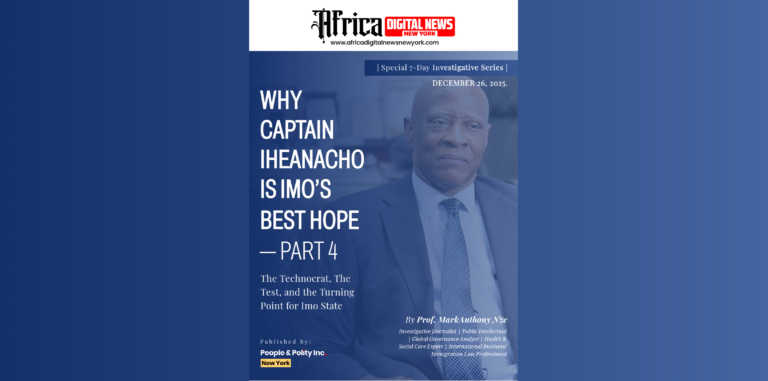
Imo has painted over rot for too long. The time has come not to renovate failure, but to rebuild function.
The Reform Blueprint
For decades, Imo has spoken the language of reform without understanding its grammar. Every administration promises change, commissions committees, and launches programs that collapse under the weight of their own slogans. Roads are flagged off before designs exist, schools are commissioned before teachers are hired, and debt grows faster than development. Reform here is not transformation — it is theatre.
Captain Emmanuel Iheanacho rejects that performance. His conception of reform is mechanical, not rhetorical — a process of redesigning malfunctioning systems until they deliver predictable results. He calls it “governance by compass”: a state guided by data, not drama.
To him, leadership is not charisma but calibration. The problem with Imo is not scarcity of ideas; it is the absence of discipline to implement them. What he proposes is a structural rebirth — one built on transparency, precision, and continuity.
Governance That Runs on Systems, Not Sentiments
In Imo today, ministries operate like isolated islands, each pursuing its own interest. Files vanish. Approvals linger. Projects are duplicated because bureaucracy has no memory. Iheanacho’s model replaces that chaos with a unified digital command structure — every project logged, every contract traceable, every naira accounted for.
He plans to establish a Public Performance Dashboard, an open digital platform where citizens and investors can monitor government activities in real time — budgets, contracts, completion rates, payments.
This is not theory. As Chairman of Integrated Oil & Gas, he introduced a digital logistics tracker linking Lagos depots with distribution terminals across the Niger Delta. The result: fuel losses dropped by nearly ninety percent within a year.
He believes that what worked at sea can work on land. Governance, like navigation, must be measurable — or it will drift.
Read also: Why Captain Iheanacho Is Imo’s Best Hope—Part 3
Reclaiming Fiscal Sanity
Imo’s finances tell a story of excess without expansion. The state’s debt burden now exceeds two hundred billion naira. Recurrent expenses consume more than four-fifths of the annual budget, leaving a mere fraction for infrastructure. The government borrows to pay salaries, then borrows again to service the loans.
Captain Iheanacho’s reform agenda begins with an audit — a full forensic review of every debt, contract, and recurring liability. No transaction will survive without documentation. He intends to cut recurrent spending through payroll digitization, reduce waste by merging redundant agencies, and prioritize capital expenditure tied directly to productivity.
Infrastructure That Generates, Not Consumes
Imo’s landscape is crowded with abandoned projects — skeletal bridges, hospitals without power, and factories overrun by grass. Iheanacho sees infrastructure not as trophy but as tool. “If it doesn’t yield,” he says, “it doesn’t last.”
His plan centers on economically self-sustaining projects. Chief among them is the Oguta Lake Port, a project that has existed for decades only on paper. To Iheanacho, it represents the state’s sleeping giant — a natural logistics corridor that could connect Imo to global shipping lanes through the Niger Delta.
His proposal: a transparent public-private concession that attracts foreign and domestic investors, creating over twelve thousand jobs and generating roughly thirty billion naira annually in port and logistics revenue.
But he does not stop at Oguta. He envisions a network of rural access roads built through concessionary models, agro-industrial parks near Ohaji’s gas corridor, and a logistics hub in Owerri that integrates air, road, and maritime freight.
For the Captain, infrastructure is not an expense; it is an engine.
Education as the Core of Competence
A state is only as intelligent as its classrooms. In Imo, many of those classrooms have collapsed — both physically and intellectually. Teachers go months unpaid. Laboratories exist only on budget lines. Students graduate unemployable.
Iheanacho’s reform blueprint treats education as the foundation of economic reform, not its accessory. He proposes a Teacher Competence and Welfare Commission to professionalize teaching, a biometric registry to eliminate ghost workers, and merit-based incentives tied to performance.
He also plans to align education with industry — building vocational and maritime training institutes linked to job pipelines in logistics, manufacturing, and energy. His guiding principle is clear: “If learning does not translate to livelihood, then education has failed.”
Security Rebuilt from the Ground Up
Under Iheanacho’s model, security becomes a system, not a slogan. The government’s current approach — reactive, politicized, and opaque — has reduced public confidence to near zero.
He proposes a Community Safety and Development Corps: an intelligence-led security network built on coordination rather than coercion. Each local government would have a security control center, integrating local vigilantes, police, and traditional institutions. Operations would be data-driven, with drone surveillance in high-risk zones and transparent reporting structures.
This approach mirrors his maritime background, where layered surveillance and disciplined communication prevent disaster. He believes that insecurity thrives not from absence of guns, but absence of governance.
Turning the Diaspora Into Stakeholders
The Imo diaspora is one of the most resourceful in Nigeria, sending home more than one hundred and eighty billion naira annually — almost ten times the state’s internally generated revenue. Yet these funds vanish into consumption because the government provides no structured investment channel.
Iheanacho’s plan is the Imo Diaspora Investment Council, a digital trust platform that allows citizens abroad to co-invest in infrastructure and enterprise projects at home, with full transparency and returns. Contributors would hold equity in development ventures, ensuring accountability and ownership.
This model converts nostalgia into nation-building — a partnership between those who left and the home they still love.
Transparency as Infrastructure
The Captain insists that transparency is not virtue — it is structure. His government would institutionalize it by law: every ministry must publish quarterly spending reports verified by independent auditors. The Auditor-General’s office would gain autonomy, with power to publish findings directly to the public without executive approval.
In a state where opacity has become custom, this reform would be seismic. It is the difference between governance as secret and governance as service.
A New Discipline for a Weary State
What distinguishes Iheanacho’s blueprint is not its ambition but its order. He does not promise miracles; he promises sequence. His governance model reads like a navigation chart — clear coordinates, measurable progress, constant recalibration.
He does not speak of “hope” as abstraction but as architecture. Hope, in his vision, is a functioning hospital. It is a school where teachers are paid. It is a road that lasts beyond one rainy season.
Imo has survived on improvisation long enough. What it needs now is instrumentation — a government that runs like a vessel: steady in storms, guided by compass, accountable to its passengers.
Conclusion: From Disorder to Design
Captain Emmanuel Iheanacho’s reform vision is not poetry — it is engineering. It translates governance from emotion to execution, from charisma to competence. He offers Imo a map out of chaos: a state that budgets honestly, spends transparently, and performs visibly.
In his world, leadership is not showmanship; it is stewardship.
If Imo ever hopes to rise from exhaustion into efficiency, it must be built by a man who understands how to rebuild systems — not slogans. And in that task, the Captain is not merely qualified; he is necessary.
Professor MarkAnthony Ujunwa Nze is an internationally acclaimed investigative journalist, public intellectual, and global governance analyst whose work shapes contemporary thinking at the intersection of health and social care management, media, law, and policy. Renowned for his incisive commentary and structural insight, he brings rigorous scholarship to questions of justice, power, and institutional integrity.
Based in New York, he serves as a full tenured professor and Academic Director at the New York Center for Advanced Research (NYCAR), where he leads high-impact research in governance innovation, strategic leadership, and geopolitical risk. He also oversees NYCAR’s free Health & Social Care professional certification programs, accessible worldwide at:
 https://www.newyorkresearch.org/professional-certification/
Professor Nze remains a defining voice in advancing ethical leadership and democratic accountability across global systems.