Foreign Precision Exposes Domestic Decay
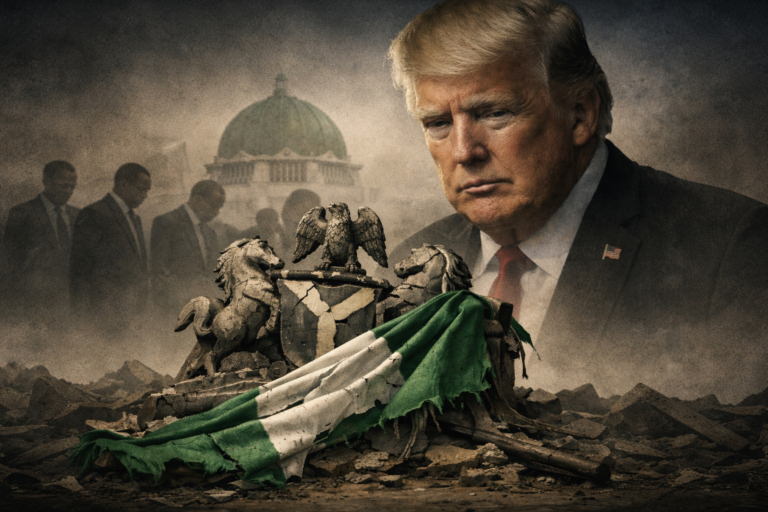
When Donald J. Trump confirmed that the United States had conducted a targeted counterterrorism strike against ISIS-linked networks in Northwestern Nigeria, global analysts called it audacious. But to those who understand the anatomy of failed states, it was inevitable. America doesn’t move into a territory for sentiment; it moves for strategy. What Trump did, intentionally or not, was expose the most dangerous truth about Nigeria: the country’s greatest security threat is not the terrorists in the forests but the politicians in the palaces.
For over a decade, Nigeria’s political and military elite have converted terrorism into a thriving shadow economy. The bloodshed is no longer collateral damage — it is business continuity. Defence budgets vanish into ghost contracts. Troop allowances are siphoned by senior officers who draft fictitious payrolls. Politicians in designer suits trade intelligence for political favors. And when the flames rise in the north, they call press conferences in Abuja and promise to “review security architecture” — the bureaucratic code for doing nothing.
According to the Global Terrorism Index, Nigeria ranks among the top three most terrorized nations on Earth, behind only Afghanistan and Iraq. Over 70,000 Nigerians have been killed, 4 million displaced, and billions lost in destroyed farmlands and abandoned communities. Yet the same leaders responsible for these collapses still parade themselves as statesmen. The Nigerian elite perfected a model where instability funds power. They cry “national security” to justify opaque budgets, then dine with the same financiers who supply weapons to insurgents.
That is the system Trump’s strike inadvertently challenged. Washington saw what Abuja refused to confront — that the Nigerian state is not failing by accident; it is failing by design.
The United States, under Trump, operates with a form of strategic realism that blends moral pretext with geopolitical advantage. It intervenes not out of compassion but calculus. Nigeria is too large, too resource-rich, and too strategically located to be ignored. With 206 million people, the largest oil reserves in Africa, and vast untapped lithium and gold deposits, Nigeria represents both a market and a risk. A destabilized Nigeria means mass migration toward Europe and the U.S., regional destabilization across the Sahel, and open corridors for Russian and Chinese influence.
Trump understands this doctrine instinctively. Where liberals debate, he acts. Where bureaucrats deliberate, he deploys. His calculus is clear: stop terrorism where it breeds, secure access to critical resources, and reassert U.S. influence in a region that has become China’s silent frontier. The operation in Northwestern Nigeria, though dressed in counterterrorism rhetoric, carries a deeper policy objective — the restoration of the American footprint in Africa’s geopolitical theater.
But irony sharpens the moment: what Nigerians call imperialism is, in truth, the accountability their leaders refused to deliver. Trump’s intervention revealed how hollow Nigeria’s sovereignty has become — a sovereignty that protects thieves, not citizens. If the Nigerian government had acted with half the precision and moral urgency of that U.S. strike, thousands of children from Borno to Zamfara would still be alive.
Read also: Champagne And Chains: Nigeria’s Christmas Of National Amnesia
Transparency International’s 2023 Defense Corruption Index ranks Nigeria among the world’s most compromised military establishments. Contracts worth billions of naira vanish into offshore accounts while soldiers on the frontlines fight with expired ammunition. The elite preach patriotism but fly their families abroad. They invoke God while negotiating ransom payments.
Terrorism has become Nigeria’s most profitable informal economy — a political currency traded for relevance, contracts, and control. Trump, with all his polarizing bravado, did what Nigerian leaders fear most — he disrupted the business model. He struck at the nexus of impunity, corruption, and cowardice that sustains the insurgency. And he did it in a language the terrorists — and the elites funding them — understand: precision and power.
To the Nigerian masses, this intervention feels like divine irony. For years, they begged their leaders for justice and got empty promises. Now, the world’s most controversial president delivers the justice their democracy denied them. It’s not that Nigerians prefer foreign control; it’s that they have stopped believing their leaders are capable of moral leadership. Between domestic tyranny and foreign pragmatism, they are choosing survival.
Still, history teaches caution. Every American intervention carries a shadow — policy leverage, resource access, and long-term influence. But even that shadow looks less sinister when compared to Nigeria’s current darkness. The Americans will demand minerals and trade alignment; the Nigerian elite demand silence and submission. One extracts resources; the other extracts hope.
Trump’s action signals a broader doctrine taking shape — one where the U.S. reasserts hard power in regions collapsing under weak governance. It’s not about policing the world; it’s about preempting global instability before it reaches American shores. And Nigeria, with its decaying infrastructure, fracturing unity, and compromised leadership, is now the test case.
The truth is brutal: Nigeria’s sovereignty has become a slogan. Its government cannot feed its people, protect its borders, or defend its integrity. Power has become an inheritance, not a responsibility. When leadership rots, external control fills the vacuum. Trump did not violate Nigeria’s sovereignty; he exposed its illusion.
There is no escaping the reckoning ahead. Either Nigeria restructures now — with regional autonomy, competent recruitment, and transparent governance or it will fragment under the weight of its deceit. The age of hiding behind colonial hangovers is over. The question is not whether America is imperial; the question is whether Nigeria still exists as a state.
Trump’s message, though couched in the language of counterterrorism, carries a brutal truth: leadership without accountability invites intervention. And when foreign drones begin doing what local governments failed to do for fifteen years, it is not foreign interference — it is justice outsourced.
Professor MarkAnthony Ujunwa Nze is an internationally acclaimed investigative journalist, public intellectual, and global governance analyst whose work shapes contemporary thinking at the intersection of health and social care management, media, law, and policy. Renowned for his incisive commentary and structural insight, he brings rigorous scholarship to questions of justice, power, and institutional integrity.
Based in New York, he serves as a full tenured professor and Academic Director at the New York Center for Advanced Research (NYCAR), where he leads high-impact research in governance innovation, strategic leadership, and geopolitical risk. He also oversees NYCAR’s free Health & Social Care professional certification programs, accessible worldwide at:
👉 https://www.newyorkresearch.org/professional-certification/
Professor Nze remains a defining voice in advancing ethical leadership and democratic accountability across global systems.