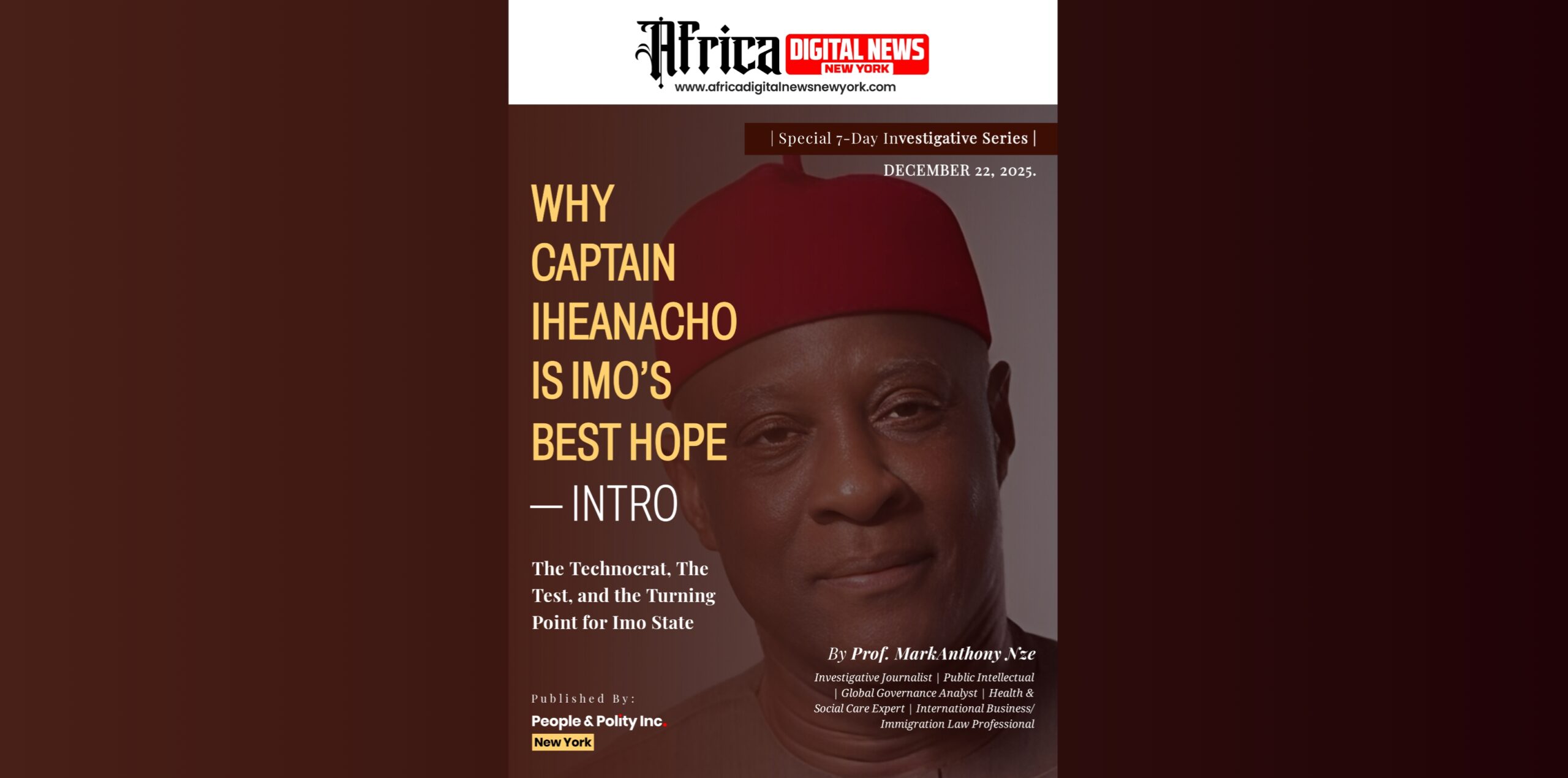
Long before politics called his name, Captain Emmanuel Iheanacho learned to command not men, but uncertainty, and to make order out of the storm.
By Prof. MarkAnthony Nze
The Man Who Refused to Sink
The horizon was a thin gray line when the engines first trembled awake. The deck smelled of diesel and salt, the sea heaving like an animal that refused taming. On mornings like this, a captain does not think about politics or legacy; he thinks about balance — the delicate math of weight, wind, and will. For Emmanuel Iheanacho, those years at sea were more than occupation. They were apprenticeship in command, the purest form of leadership: calm under duress, clarity in noise, conscience in solitude.
It was in those dawns — when the world was nothing but metal, water, and faith — that his philosophy took shape: systems fail when men panic. He has lived by that creed ever since.
The Quiet Commander
People who have worked with Iheanacho describe him not as charismatic, but gravitational. He draws attention by resisting it. His meetings are silent until he speaks; his instructions rarely need repetition. “He has the patience of someone who has waited out storms,” said a former aide. “He listens longer than most leaders can tolerate, then he makes one decision — usually the correct one.”
In a country that confuses loudness for leadership, that restraint feels almost alien. Yet it explains why those who know him trust him with things they would not entrust to others: ships, budgets, ministries — now perhaps, a state.
When the Bureaucracy Tilted
In the archives of Nigeria’s civil service are quiet stories of reformers who entered government like engineers and left like exiles. Iheanacho’s name belongs among them. When he took charge of a chaotic system, he approached it the way a navigator studies a faulty compass: methodically, not emotionally. Files were audited, chains of command re-drawn, obsolete rules replaced with measurable procedures.
Civil servants accustomed to political theater found themselves reporting to a man who counted outcomes, not headlines. Some adapted. Others resisted. When they pushed back, expecting negotiation, he refused. “Rules are not requests,” he told a director who wanted exceptions. That sentence, simple as it was, became his signature — the statement of a man allergic to corruption disguised as compromise.
Read also: Why Captain Iheanacho Is Imo’s Best Hope
The Fall and the Silence
Every honest administrator in Nigeria eventually discovers the cost of integrity. Iheanacho learned his when he refused to sign inflated contracts that would have enriched the powerful. The system expelled him with polite cruelty — a suspension letter, a whisper campaign, a cabinet reshuffle.
He did not call a press conference. He packed his files, thanked his staff, and left. For months afterward, journalists tried to bait him into bitterness. His answer never changed: “A captain does not curse the sea.”
That response baffled an audience conditioned to outrage. Yet it revealed something fundamental about his character — that dignity, for him, is not performance. It is policy.
Between Principle and Power
What separates Iheanacho from the archetypal Nigerian politician is not ambition but motive. He does not speak of power as conquest; he speaks of it as calibration — the management of motion. “Politics,” he once told a colleague, “should be like navigation: everyone on board arrives or nobody does.”
That worldview explains his distance from the excesses of the political class. He neither flatters godfathers nor ridicules rivals. Instead, he studies systems, identifies faults, and quietly fixes them. Where others promise miracles, he builds processes.
To a state weary of theatrics, that precision is not just refreshing; it is revolutionary.
An Unlikely Firebrand
Still, the calm exterior hides steel. Beneath the composed diction and maritime metaphors lies a man unyielding to deceit. He does not shout; he outlasts. During negotiations with oil marketers years ago, when tempers flared and alliances shifted, he simply paused, opened a logbook, and read out figures none could dispute. The room fell silent. The meeting ended in agreement.
Facts are his chosen weapon — cold, irrefutable, unsentimental. It is how he dismantles chaos: by replacing noise with numbers.
A Mirror to Imo
Today, Imo State resembles a vessel in distress: debt flooding its hull, leadership quarreling over the compass, crewmen abandoning post. The noise from above decks — press releases, ribbon cuttings, televised promises — cannot conceal the drift. What the ship needs is not another officer shouting into the wind, but someone who understands how to restore equilibrium.
That is why Iheanacho’s story feels prophetic. His life has always been about rescue — not dramatic, last-minute salvation, but the slow, disciplined work of correction.
When he speaks about rebuilding Imo, he does not conjure metaphors of “miracles” or “prosperity.” He speaks of audits, logistics, maintenance, and accountability. To politicians, those words sound unromantic. To engineers, managers, and citizens who live with the consequences of neglect, they sound like hope.
The Measure of Calm
There is a photograph of Iheanacho taken years ago aboard a freighter: wind in his coat, clipboard in hand, eyes fixed on the horizon. He is neither posing nor performing; he is calculating — distance, direction, probability. That image encapsulates his essence. He is a man perpetually assessing risk, perpetually seeking balance.
It is the same mindset he brings to politics: a refusal to be rushed by hysteria, a belief that order — however delayed — is achievable through method. In a state governed by improvisation, that attitude could be transformative.
The Captain’s Code
Every system he has entered has tested his resolve: the sea with its tempests, bureaucracy with its corruption, politics with its cynicism. Each tried to drown him in its own way. Each failed.
Now, as Imo faces another storm — fiscal collapse, insecurity, public distrust — the same qualities that once made him an outlier may make him indispensable.
He has no illusions about easy victories. “There are no shortcuts on water,” he once said. “You either steer correctly or you sink.”
That line could just as easily be addressed to Imo itself.
Professor MarkAnthony Ujunwa Nze is an internationally acclaimed investigative journalist, public intellectual, and global governance analyst whose work shapes contemporary thinking at the intersection of health and social care management, media, law, and policy. Renowned for his incisive commentary and structural insight, he brings rigorous scholarship to questions of justice, power, and institutional integrity.
Based in New York, he serves as a full tenured professor and Academic Director at the New York Center for Advanced Research (NYCAR), where he leads high-impact research in governance innovation, strategic leadership, and geopolitical risk. He also oversees NYCAR’s free Health & Social Care professional certification programs, accessible worldwide at:
👉 https://www.newyorkresearch.org/professional-certification/
Professor Nze remains a defining voice in advancing ethical leadership and democratic accountability across global systems.