
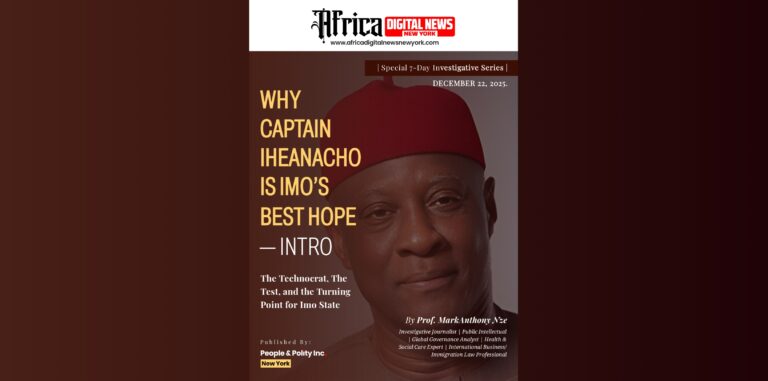
Introductory Overview
Every state, at moments of moral exhaustion, reaches a reckoning point, a moment when it must decide whether to continue drifting on the tides of mediocrity or to anchor itself on competence. For Imo State, that moment has arrived. Beneath the noise of political sloganeering, under the fatigue of broken promises and the quiet despair of its people, one truth is now undeniable: Imo’s crisis is not merely political; it is architectural. It is a collapse of governance design, of leadership culture, of values. And in that vacuum, the search for a stabilizing force — for a governor who understands both systems and sacrifice — has found an unlikely yet undeniable compass in Captain Emmanuel Iheanacho.
A retired Merchant Navy officer, shipping magnate, former Minister of Interior, and global maritime expert, Captain Iheanacho is not just another aspirant in a state addicted to political recycling. He is a professional defined by precision — the kind of man who reads tides, not tempers; who navigates complexity, not chaos. His rise from a young cadet in Imo to the bridge of international shipping vessels, and later to Nigeria’s federal cabinet, tells the story of an Imolite who has lived systems, not slogans.
Imo’s people have had governors who could speak eloquently; what they have lacked are leaders who could administer. Between 2020 and 2025, the state’s debt profile ballooned to over ₦205 billion, an increase of more than 40 percent in four years, according to data from the Debt Management Office. Recurrent expenditure now consumes 83 percent of the annual budget, leaving capital projects perpetually underfunded. Youth unemployment stands at 41.2 percent, one of the highest in southern Nigeria. In the 2025 BudgIT “State of States” Report, Imo ranked 33rd out of 36 in fiscal sustainability, with less than ₦6 billion in internally generated revenue against ₦13 billion in monthly federal allocation.
Read also: Governor Uzodinma: The Worst Disaster Bedevilling Imo State
The contradiction is staggering. This is a state with over 5 million people, three seaports within 90 kilometers, the largest natural gas reserves in the southeast, and one of Nigeria’s most educated populations — yet it operates as though prosperity were forbidden by design. Roads built last year have already failed; pensioners sleep in queues for unpaid arrears; schools operate with barely two teachers for entire classes.
It is against this backdrop of dysfunction that Iheanacho’s name has re-emerged, not as nostalgia but as necessity.
The Man Who Understands Systems
Educated at the University of Wales, Cardiff, where he earned a Master’s degree in International Transport, and at the University of Bradford, where he obtained an MBA in General Management, Iheanacho belongs to a generation that measured success by performance, not publicity. In the maritime industry — a sector where inefficiency means catastrophe — he built a reputation for meticulousness. As Managing Director of Genesis Worldwide Shipping and later Chairman of Integrated Oil and Gas Ltd, he turned complex logistics into sustainable business, employing hundreds and setting standards in safety and compliance.
When he entered public service in 2010 as Minister of Interior under President Goodluck Jonathan, Iheanacho’s approach remained consistent: structured, humane, and data-driven. He audited the Nigerian Prisons Service and discovered that over 30,000 inmates were awaiting trial — some for up to a decade. Within months, he initiated reforms that led to the creation of the Civil Defence College for Peace and Disaster Management in Katsina, modernized prison administration, and advocated the digitization of inmate records.
His brief suspension in 2011, far from a stain, revealed his moral compass: he refused to sign off on inflated procurement contracts. In a system built on compromise, he became a rare example of refusal — the kind that history eventually vindicates.
The Case for Competence
Imo’s problems today are not philosophical; they are managerial. The state needs a leader who understands budgets, supply chains, energy systems, and human capital development. Iheanacho’s maritime background is an asset here. The Oguta Lake Port Project, abandoned for decades, could transform into an inland shipping hub under a leader who knows how global ports operate. With the right concession model, it could generate ₦30 billion annually, create 12,000 jobs, and integrate Imo into West Africa’s maritime corridor.
His experience in oil logistics positions him to pursue industrial diversification — establishing modular refineries, reviving agro-based exports, and leveraging Imo’s gas fields for clean energy industries. While other candidates trade in slogans of “shared prosperity,” Iheanacho speaks the language of infrastructure audit, energy transition, and maritime logistics. He has managed billion-naira enterprises; he knows how to make numbers talk.
A Reputation Untouched by Greed
In a political environment where scandal is oxygen, Iheanacho remains unblemished. No corruption indictment, no financial probe, no history of political violence. His corporate transparency has made him a model for Nigeria’s Indigenous Ship Owners Association, where he once served as Vice President. He has argued consistently for Nigerian content in shipping and for transparent subsidy reforms — long before the national conversation caught up.
It is no surprise that Imo’s diaspora community — spanning London, Houston, Johannesburg, and Toronto — sees in him a candidate who understands both home and abroad. In 2024 alone, Imo’s diaspora remittances exceeded ₦180 billion, yet the current administration has no diaspora investment framework. Iheanacho, a global executive and UN maritime consultant, speaks their language of accountability and international standards.
A State on the Edge of Renewal
The truth is simple but brutal: if Imo continues on its current trajectory, it will become fiscally insolvent within the next decade. The symptoms are already visible — rising debt, crumbling infrastructure, and youth flight. Governance has become theater; policy, an afterthought. The state that once produced scholars and engineers now exports despair.
Captain Iheanacho’s candidacy, therefore, is not a partisan ambition — it is a referendum on competence itself. His life’s work has been the art of navigation: reading storms, adjusting course, and bringing vessels home. That is precisely what Imo needs — a navigator, not a performer.
The Verdict of History
In a state weary of improvisation, Captain Emmanuel Iheanacho represents structure. In a culture that rewards flamboyance, he embodies restraint. In a time of cynicism, he offers credibility built on a lifetime of measurable achievement.
This series will examine, over seven days, not merely why he can lead but why Imo cannot afford anyone else. The argument will rest not on sentiment but on evidence — the same standard by which the captain has always lived his life.
Imo has drifted long enough. Its people deserve a governor who knows how to read a compass, and the courage to follow it.
Professor MarkAnthony Ujunwa Nze is an internationally acclaimed investigative journalist, public intellectual, and global governance analyst whose work shapes contemporary thinking at the intersection of health and social care management, media, law, and policy. Renowned for his incisive commentary and structural insight, he brings rigorous scholarship to questions of justice, power, and institutional integrity.
Based in New York, he serves as a full tenured professor and Academic Director at the New York Center for Advanced Research (NYCAR), where he leads high-impact research in governance innovation, strategic leadership, and geopolitical risk. He also oversees NYCAR’s free Health & Social Care professional certification programs, accessible worldwide at:
👉 https://www.newyorkresearch.org/professional-certification/
Professor Nze remains a defining voice in advancing ethical leadership and democratic accountability across global systems.