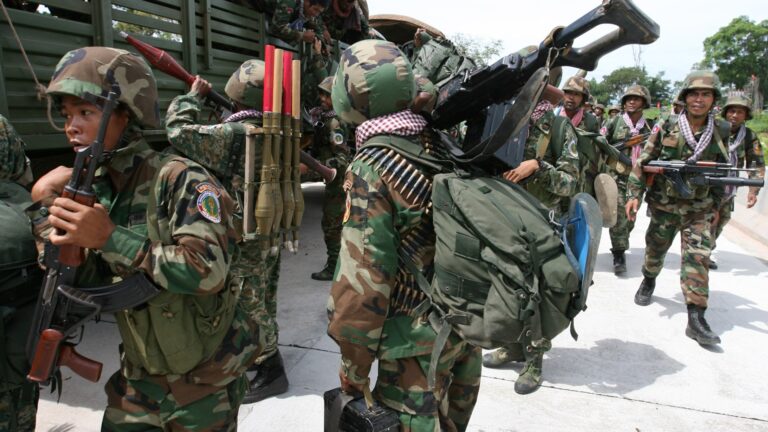
Fighting between Thailand and Cambodian forces continued early Saturday, despite US President Donald Trump saying the two countries had agreed to halt hostilities, showing the fragility of diplomatic efforts to end the border clashes.
Shelling and ground operations resumed overnight along disputed sections of the frontier as Thai troops moved to secure elevated positions, according to military officials. The renewed violence came hours after Trump announced on social media that Bangkok and Phnom Penh had accepted a ceasefire.
At least 21 people have been killed since the latest escalation began earlier this week, and roughly 700,000 civilians have been displaced on both sides of the border, according to government figures.
Thai Prime Minister Anutin Charnvirakul said a ceasefire could only take effect after Cambodia withdrew its forces and cleared landmines from contested areas.
In a social media post early Saturday, Anutin said Thailand would continue military operations until it no longer faced threats to its territory or citizens. “Thailand will continue to perform military actions until we feel no more harm and threats to our land and people,” he wrote. “Our actions this morning already spoke.”
Anutin added that he told Trump directly that Thailand was not the aggressor and that Cambodia needed to demonstrate compliance before any pause in fighting could occur. “They must show us first,” he said.
Trump said on Friday night that he had spoken separately with the leaders of Thailand and Cambodia and that both sides had agreed to stop shooting and return to a ceasefire framework signed in October.
Writing on social media, Trump said the ceasefire would take effect immediately and described both countries as “ready for peace.” The earlier agreement was brokered by Trump alongside Malaysian Prime Minister Anwar Ibrahim and formalized at a ceremony in Malaysia.
Thai officials, however, made no reference to immediate implementation and warned Washington against linking the conflict to trade matters. In previous flare ups, the United States had raised the possibility of trade pressure, a move Thailand has cautioned against.
Cambodia said it was hit by additional Thai air strikes on Saturday, further calling into question the ceasefire claim.
In a statement posted on X, Cambodia’s defense ministry said Thai forces used two F 16 fighter jets to drop seven bombs on multiple targets. “Thai military aircraft have not stopped bombing yet,” the ministry said.
Read Also: Cambodian Border Clashes Trigger Mass Evacuations
The Thai military confirmed that fighting was ongoing but did not provide details on specific operations.
Both countries have repeatedly accused each other of initiating the latest violence, which intensified after clashes earlier this week left soldiers wounded on both sides.
The current fighting traces back to a long running territorial dispute along the roughly 800 kilometer border between Thailand and Cambodia. The boundary was drawn in 1907 by French colonial authorities, and its interpretation has been contested for decades.
Tensions spiked again on July 24, when Cambodia launched a barrage of rockets into Thai territory. Thailand responded with air strikes, and several days of heavy fighting followed.
After dozens of deaths, the two Southeast Asian neighbors agreed to an “immediate and unconditional ceasefire” brokered by Trump and Anwar. Even after that agreement, both sides accused the other of violations.
Thailand has published evidence it says shows Cambodian forces laying landmines, incidents that have cost seven Thai soldiers their limbs. Cambodia denies planting new mines and says explosives in the area date back to its civil war in the 1980s.