Bulgaria’s Prime Minister Rosen Zhelyazkov stepped down late Wednesday after huge crowds filled central Sofia and other cities demanding his government quit over corruption concerns. His resignation came just hours before a scheduled no-confidence vote in parliament and less than three weeks before Bulgaria is set to adopt the euro.
The move followed days of swelling demonstrations against his minority centre-right administration, which took office in January. Protesters accused the government of protecting powerful political figures and business interests, and of failing to tackle long-standing graft.
In a televised address, Zhelyazkov said he was responding to the clear message sent by the public. “We hear the voice of citizens protesting against the government,” he said, adding that both younger and older demonstrators had called for his resignation. He described the protests as “civic energy” that deserved support rather than confrontation.
A government statement later confirmed that ministers would remain in place in a caretaker capacity until a new cabinet is chosen.
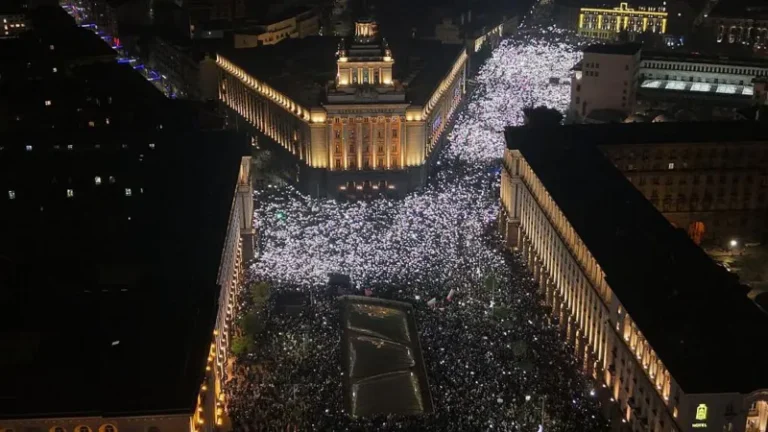
Crowds estimated at between 50,000 and 100,000 gathered in Sofia’s Triangle of Power and Independence Square on Wednesday night, according to local media. Laser projections reading “Resignation” and “Mafia Out” lit up the parliament building as the demonstrations intensified.
President Rumen Radev, who last week urged the government to resign, reiterated his support for the protesters.
Many demonstrators focused their anger on two influential figures: Delyan Peevski, an oligarch sanctioned by the United States and United Kingdom for alleged corruption, and former prime minister Boyko Borissov.
According to Bulgaria’s BTA news agency, Wednesday’s rally was organised under the slogan “Resignation! Peevski and Borissov Out of Power.” Peevski’s party has supported the current government in parliament, while Borissov leads the GERB party, which finished first in the October 2024 elections.
Read Also: Mexico Attorney General Resignation Approved By Senate
Borissov reportedly said earlier on Wednesday that the governing coalition had agreed to stay in office until Bulgaria joined the eurozone on 1 January. He previously faced large anti-corruption protests in 2020 that brought down his government, followed by years of political instability and seven national elections.
Despite the turmoil, Bulgaria’s planned entry into the eurozone is not expected to be affected, according to economists and EU officials quoted by Reuters and other outlets. The country has been preparing for the transition for several years, and the technical process is largely complete.
Zhelyazkov acknowledged in his resignation statement that Bulgaria faces a significant challenge as it approaches the currency shift. He urged citizens to put forward “authentic proposals” for the shape of the next government.
Bulgaria remains among the lowest-ranked EU countries in Transparency International’s annual index on public sector corruption, positioned close to Hungary and Romania. Analysts say repeated political deadlock and weak coalition governments have made systemic reform difficult.