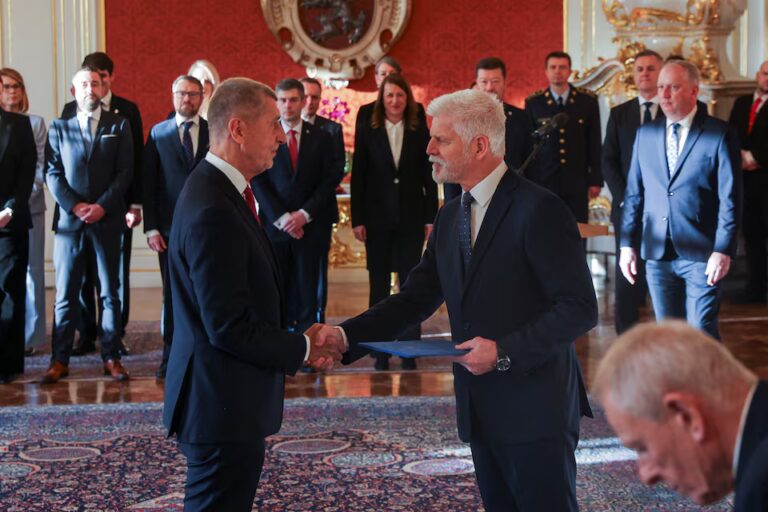
Czech President Petr Pavel on Tuesday formally appointed billionaire Andrej Babis as prime minister, returning the populist leader to office after his ANO party won parliamentary elections earlier this month.
The appointment, broadcast live on national television, clears the way for a new government once Babis presents his full cabinet, which is expected later this month. He replaces a centre right administration that governed after narrowly defeating ANO in the previous election cycle.
The move marks a significant political shift in Prague, with implications for Czech foreign policy, relations with the European Union, and support for Ukraine.
Babis leads ANO as it forms a coalition with the far right Freedom and Direct Democracy party, known as SPD, and the Motorists for Themselves party. Both partners are openly critical of the European Union, with the Motorists focusing heavily on opposition to EU climate policies.
The incoming government is expected to adopt a more skeptical stance toward Brussels and to review Czech commitments tied to EU environmental rules. Analysts say the coalition reflects voter frustration with high energy costs and inflation rather than a clear foreign policy mandate.
Babis has said his government plans to reduce military assistance to Ukraine funded directly from the national budget. He has also raised doubts about the future of a Czech led initiative that sources large calibre ammunition for Ukraine from international suppliers.
The prime minister designate previously described the ammunition scheme as expensive and lacking transparency. However, he has stopped short of confirming whether the programme will be scrapped entirely, despite strong backing from President Pavel, a former NATO general.
Read Also: European Leaders Support Zelenskiy In London Peace Talks
Czech officials say the initiative has played a visible role in keeping ammunition supplies flowing to Kyiv as the war with Russia grinds on.
President Pavel’s decision to appoint Babis followed an announcement last week that the prime minister would transfer his ownership of Agrofert into trust structures. The conglomerate includes more than 200 companies spanning agriculture, food production, chemicals, and media.
The move is aimed at resolving longstanding conflict of interest concerns that have shadowed Babis throughout his political career, including scrutiny from European institutions during his previous term.
Babis has said the trust arrangement allows him to focus fully on governing without violating Czech or EU rules.
Once the cabinet is approved, parliament will vote on confidence in the new government. Political observers expect tense debates over defense spending, relations with Brussels, and the future of Czech involvement in support for Ukraine.
The direction of those decisions will be closely watched across Central Europe and by allies in NATO and the EU.