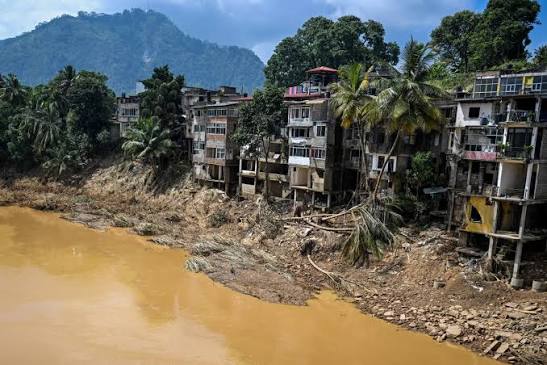
Sri Lanka entered another anxious day on Friday as heavy rains soaked the island’s central highlands, prompting fresh landslide warnings and deepening the tragedy left behind by Cyclone Ditwah. The death toll, already staggering, climbed to 607—many of them victims of mudslides that buried entire stretches of hillside communities.
The National Building Research Organisation, which monitors the stability of the island’s mountain slopes, warned that rainfall over the past 24 hours had exceeded 150 millimetres, saturating soil that was already dangerously unstable. If the downpour continues, officials urged residents to evacuate before the hills give way again.
The latest rains are tied to the arrival of the monsoon season, even as some of last week’s severe flooding has begun to recede. But the scale of destruction left behind remains overwhelming. The Disaster Management Centre said many of the people earlier listed as missing are now presumed dead, revising the number of the unaccounted down to 214 while noting that more than two million residents have been affected across the island.
Refugee camps, once crowded with 225,000 displaced people, now house around 150,000 as waters slowly withdraw from Colombo and surrounding districts. Yet large portions of the country remain inaccessible, buried in mud or cut off by damaged roads and bridges.
President Anura Kumara Dissanayake has called the disaster the most severe natural catastrophe in Sri Lanka’s history. He acknowledged that the economic fallout has forced the government to delay an upcoming $347 million IMF disbursement, seeking instead to renegotiate a larger package in light of the island’s radically altered financial landscape.
New landslide alerts issued Friday expanded the list of high-risk zones, with authorities urging residents not to return to their homes—even those spared by earlier slips. In Gampola, a town struggling to dig out from thick layers of mud, volunteers worked shoulder-to-shoulder with residents to salvage waterlogged homes. “It takes ten men a full day to clean one house,” a volunteer named Rinas said, pausing from the work of hauling debris.
Read Also: Harvard: Crypto Exchange Ostium Secures $20 Million Series A
Thousands of troops have been deployed to assist with clearing operations, while the government estimates reconstruction costs could reach between $6 billion and $7 billion. Yet amid the devastation, Sri Lanka’s tourism authorities insisted that hotels have reopened and nearly 300 stranded visitors have already been airlifted to safety.
“We need tourism revenues to help rebuild,” Deputy Tourism Minister Ruwan Ranasinghe said—a reminder that even in crisis, the country is already searching for its path back to stability.