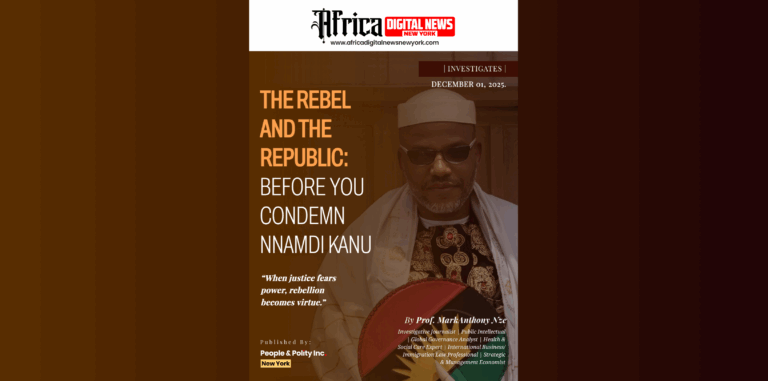
The Burden of an Imperfect Patriot
It takes neither courage nor wisdom to condemn a man already in chains. Nnamdi Okwu Kanu’s name has become a political fault line, a litmus test of loyalty, identity, and fear. His detractors call him a menace; his followers, a messiah. But the truth, as always, lies between worship and vilification.
Kanu is no saint. His words have sometimes wounded his own cause; his methods occasionally alienated those who might have been allies. Yet the measure of his rebellion cannot be taken by the yardstick of civility. History has never birthed freedom through politeness. From Ireland’s Michael Collins to South Africa’s Nelson Mandela, those who confront unjust systems often do so imperfectly, because injustice itself distorts the ground on which one must stand.
Mandela once sanctioned armed resistance not because violence ennobled him, but because peace had been denied. Kanu’s defiance emerged from a similar exhaustion, a conviction that a people cannot beg for dignity from a state that profits from their humiliation. His language was the language of fury, but his fury was not without reason.
When Truth Became Treason
Nigeria’s tragedy is not simply that injustice thrives; it is that truth has become negotiable. In the narrative crafted by the state, Kanu is a destabilizer, the architect of chaos in the South-East. Yet, beneath that propaganda lies in a more uncomfortable reality: his rise is the direct consequence of the Republic’s own betrayals.
For decades, the South-East has lived at the periphery of national power; its sons denied federal appointments, its roads abandoned, its industries strangled by policy, and its grief ignored. The federal government could not silence resentment, so it silenced the man who gave that resentment a voice.
When security agencies turned the region into a militarized zone, they claimed to be restoring order. Amnesty International’s 2023 report, however, documented a different story: summary executions, arbitrary detentions, and collective punishment masquerading as national security. It was in this climate that politicians found convenience in blood, exploiting every death for votes while branding dissent as treason.
The people’s pain was never on trial—only their anger was. And Kanu became the vessel for both.
Read also: The Imperative For Global Action: The Case Of Nnamdi Kanu
The Constitution They Ignored
Section 35 of the 1999 Constitution guarantees liberty except by lawful order. Section 36 enshrines the right to fair hearing and prohibits punishment without due process. Yet, these provisions meant little when the state abducted Kanu from a foreign jurisdiction in violation of international law, an act condemned by the United Nations Human Rights Committee in 2019 as a “flagrant breach of sovereignty and due process.”
When Justice James Omotosho sat to decide Federal Republic of Nigeria v. Nnamdi Kanu, he was not merely ruling on a defendant, he was ruling on the Constitution itself. But his judgment chose silence over scrutiny. The doctrine of fair trial was recited but not respected. The court became less a sanctuary of justice and more a stage for validation.
The African Bar Association in its 2024 judicial independence report called this “procedural surrender to executive will.” It is a phrase that captures the tragedy of Nigeria’s judiciary: it performs legality while enacting obedience.
In that courtroom, the Constitution did not lose its words, it lost its meaning.
The Imperfect Rebel, The Flawed Republic
There is no denying that Kanu’s rhetoric was combustible. His broadcasts sometimes crossed moral boundaries, feeding fear where persuasion was needed. Yet, the legitimacy of his grievance remains unassailable. The right to self-determination is not a crime; it is codified in Article 20 of the African Charter on Human and Peoples’ Rights, which Nigeria domesticated into law.
To criminalize that right is to criminalize history itself. The South-East’s cry is not for secession alone; it is for justice long deferred. Kanu’s movement filled a vacuum created by political failure. Where the government offered neglect, he offered voice. Where the courts offered delay, he offered urgency. Where the elite offered compromise, he offered confrontation.
His imperfection was not moral deficiency—it was the inevitable roughness of a man confronting a system that had forgotten humanity.
Where Justice Learned to Kneel
The Nigerian judiciary no longer trembles for justice, it trembles before power. Within the marble walls of its courtrooms, silence has replaced conviction. Judges now whisper verdicts that once thundered with independence. The CLEEN Foundation’s 2022 judicial integrity survey exposed a devastating truth: most judges in politically sensitive cases acknowledge invisible hands guiding their restraint. The Rule of Law and Accountability Advocacy Centre warned a year later that “judicial restraint has evolved into judicial fear.”
Justice Omotosho did not create this fear, but he gave it new grammar. His judgment was a study in technical obedience, meticulously worded, scrupulously tidy, and spiritually vacant. Every paragraph bowed before the specter of authority. He never raised his voice; he didn’t need to. Submission, dressed in civility, does not shout—it breathes quietly through the pages of legal precision.
What the judgment gained in polish, it lost in principle. It showed that the bench has learned survival as a method and silence as a strategy. When the robe becomes an armor against consequence rather than a symbol of conscience, justice ceases to live—it merely endures.
A judiciary that fears its own independence cannot defend liberty. And a nation that trains its judges to obey power will soon discover that law without courage is merely literature.
The People Behind the Headlines
The Kanu case is not only about politics; it is about people. Behind every headline is a mother who lost a son to stray bullets, a student detained without charge, a journalist silenced for asking questions. Their stories rarely reach the courtrooms where laws are debated in abstraction.
In Orlu, in Ihiala, in Okigwe, families speak of security raids conducted without warrants, of homes burned in reprisal, of lives erased from the state’s ledger of empathy. Their grief has no grammar, but it is the evidence the nation refuses to admit.
The politicians who exploit their tragedy will retire into privilege. The soldiers who executed illegal orders will claim obedience. But the mothers who bury their children will carry memory as their only justice.
The Moral Equation
Kanu’s cause, at its heart, is not separatism—it is protest against invisibility. He demanded recognition in a nation that insists on selective citizenship. His imprisonment will not end that demand; it will amplify it.
Before Nigeria condemns Kanu, it must first confront its own duplicity. It cannot celebrate the resistance of Mandela and vilify the defiance of those who follow his path. It cannot preach federal unity while practicing sectional exclusion. It cannot claim to uphold justice while punishing its pursuit.
The danger is not that Kanu will divide Nigeria—the danger is that Nigeria will remain divided by its refusal to listen.
Professor MarkAnthony Ujunwa Nze is an acclaimed investigative journalist, public intellectual, and global governance analyst whose work shapes contemporary thinking at the intersection of health and social care management, media, law, and policy. Renowned for his incisive commentary and structural insight, he brings rigorous scholarship to questions of justice, power, and institutional integrity.
Based in New York, he serves as a full tenured professor and Academic Director at the New York Center for Advanced Research (NYCAR), where he leads high-impact research in governance innovation, strategic leadership, and geopolitical risk. He also oversees NYCAR’s free Health & Social Care professional certification programs, accessible worldwide at:
https://www.newyorkresearch.org/professional-certification/
Professor Nze remains a defining voice in advancing ethical leadership and democratic accountability across global systems.
Bibliographies
African Bar Association. (2024). Judicial Independence and Political Compliance in Sub-Saharan Africa. Lagos: AfBA Secretariat.
Amnesty International. (2023). Nigeria: Human Rights Under Siege – National Security Trials and Detentions. London: Amnesty International.
Centre for Democracy and Development. (2023). Judicial Prudence and Political Stability in Nigeria. Abuja: CDD.
CLEEN Foundation. (2022). Judicial Integrity and Institutional Pressure: A Survey of Nigerian Judges. Lagos: CLEEN Foundation.
Human Rights Watch. (2024). Justice Captured: Nigeria’s Courts and the Crisis of Independence. New York: HRW.
International Commission of Jurists. (2023). The Procedural Domestication of Executive Will: Judicial Independence in Decline. Geneva: ICJ.
National Judicial Council. (2023). Annual Report on Judicial Performance and Administrative Influence. Abuja: NJC Secretariat.
Nigerian Bar Association. (2024). The Rule of Law at Risk: Judicial Courage and Constitutional Duty in Nigeria. Abuja: NBA.
Rule of Law and Accountability Advocacy Centre. (2023). Judicial Self-Censorship and National Security Cases in Nigeria. Lagos: RULAAC.
Transparency International Nigeria. (2023). Judicial Integrity Index 2023: Public Confidence in Nigeria’s Courts. Abuja: TI-Nigeria.
United Nations Human Rights Committee. (2019). General Comment No. 32: Right to a Fair Trial (Article 14). Geneva: OHCHR.
Open Society Justice Initiative. (2020). Courts and Constitutional Regression in Africa. New York: Open Society Foundations.
African Commission on Human and Peoples’ Rights. (2022). Resolution on the Rule of Law and Judicial Independence in Africa. Banjul: ACHPR.
Centre for Human Rights, University of Pretoria. (2023). Nigeria’s Judiciary and the Erosion of Constitutional Safeguards. Pretoria: CHR-UP.
The Guardian Nigeria. (2024, March 15). Kanu’s Trial and the Question of Judicial Neutrality. Retrieved from https://guardian.ng